


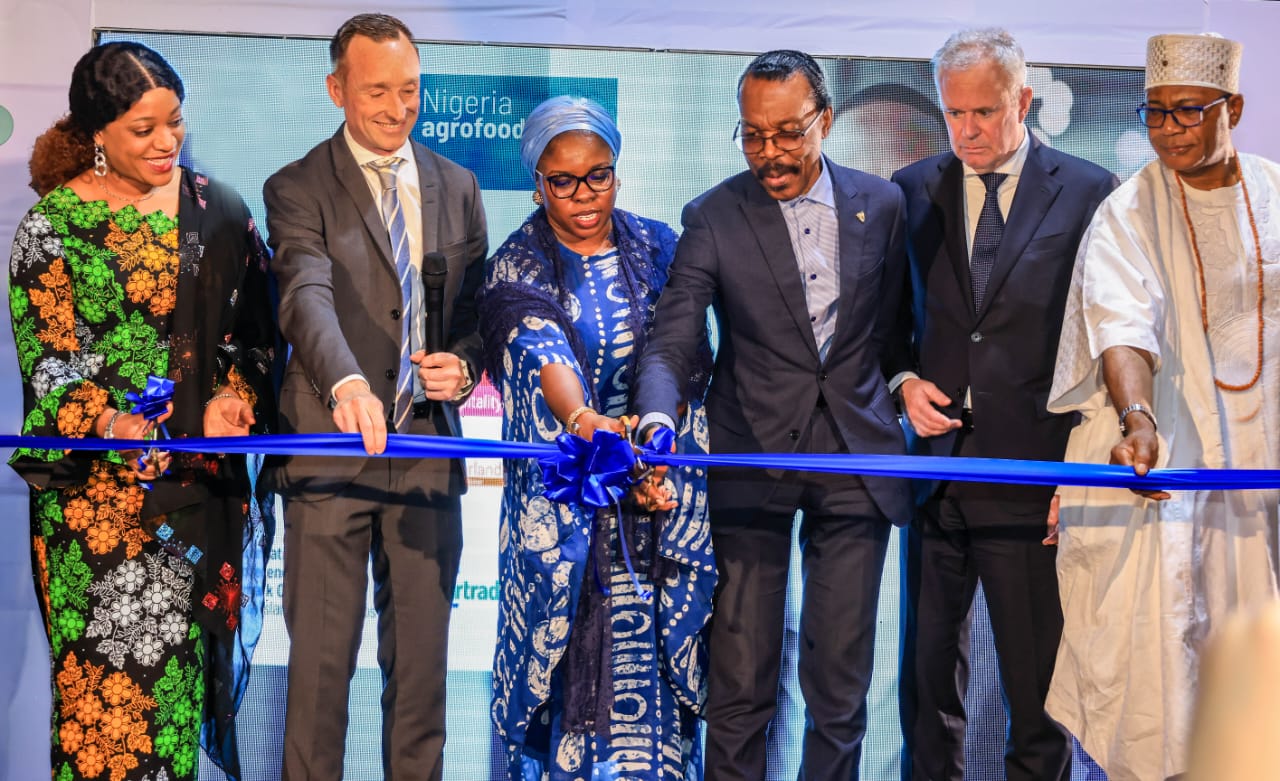
The 11th edition of Agrofood Nigeria has spotlighted the country’s vast agrofood market potential, projected to reach €222 billion by 2026, while industry leaders raised concerns over persistent post-harvest losses and weak value chain systems.
The three-day exhibition and conference, organised by fairtrade Messe GmbH in partnership with Modion Communications, convened stakeholders from across Nigeria and the international community to explore solutions for strengthening agricultural productivity and industrial growth.
The event held in Lagos featured 137 exhibitors across key sectors including agro, food and beverage technology, food ingredients, packaging, and food and hospitality.
Speaking at the conference, Governor Babajide Olusola Sanwo-Olu, represented by the Commissioner for Agriculture and Food Systems, Ruth Abiola Olusanya, described Lagos as a critical hub in Nigeria’s food ecosystem.
He noted that Lagos is Africa’s largest single food consumption market, with its food economy expanding from ₦6.5 trillion in 2019 to over ₦16 trillion, and accounting for more than half of food traded within the South-West region.
“As a state contributing about 22 per cent of Nigeria’s GDP, Lagos provides a structured and accessible market for investments in agro-processing, cold chain systems, packaging, and food technology,” he said.
The conference, themed “Achieving World-Class Food Security in Nigeria,” drew participation from key figures including Helen Eno-Obareki – representing Akwaibom First Lady; Managing Director of fairtrade Messe, Paul Marz; and economist Bismarck Rewane.
Rewane warned that ongoing geopolitical tensions in the Middle East could have adverse ripple effects on Nigeria’s food prices and supply chains, urging stakeholders to prepare for further economic shocks.
A major concern raised at the event was the scale of post-harvest losses across the country.
President of the Organization for Technology Advancement of Cold Chain in West Africa (OTACCWA), Alexander Isong, stated that Nigeria loses between ₦3.5 trillion and ₦5 trillion worth of food annually – equivalent to 30 to 40 million metric tonnes – due to inadequate storage infrastructure and poor logistics.
He added that more than 97 per cent of Nigeria’s agricultural exports are shipped in raw form, limiting value addition and export earnings.
President of the Manufacturers Association of Nigeria, Francis Meshioye, highlighted the broader global context, noting that about 733 million people faced hunger in 2023, with Africa experiencing the most severe impact.
Similarly, the President of the Nigerian Association of Chambers of Commerce, Industry, Mines and Agriculture, Jani Ibrahim, stressed that achieving world-class food security in Nigeria is attainable but requires sustained investment, policy alignment, and collaboration across the public and private sectors.
The event hosted exhibitors from 15 countries across four continents, including Germany, the Netherlands, China, India, South Africa, the United States, and the United Kingdom, reflecting growing international interest in Nigeria’s Agrofood sector.
Stakeholders concluded that while Nigeria’s Agrofood industry holds significant growth potential, unlocking its full value will depend on addressing structural inefficiencies, particularly in storage, processing, and distribution systems.





Comment here