


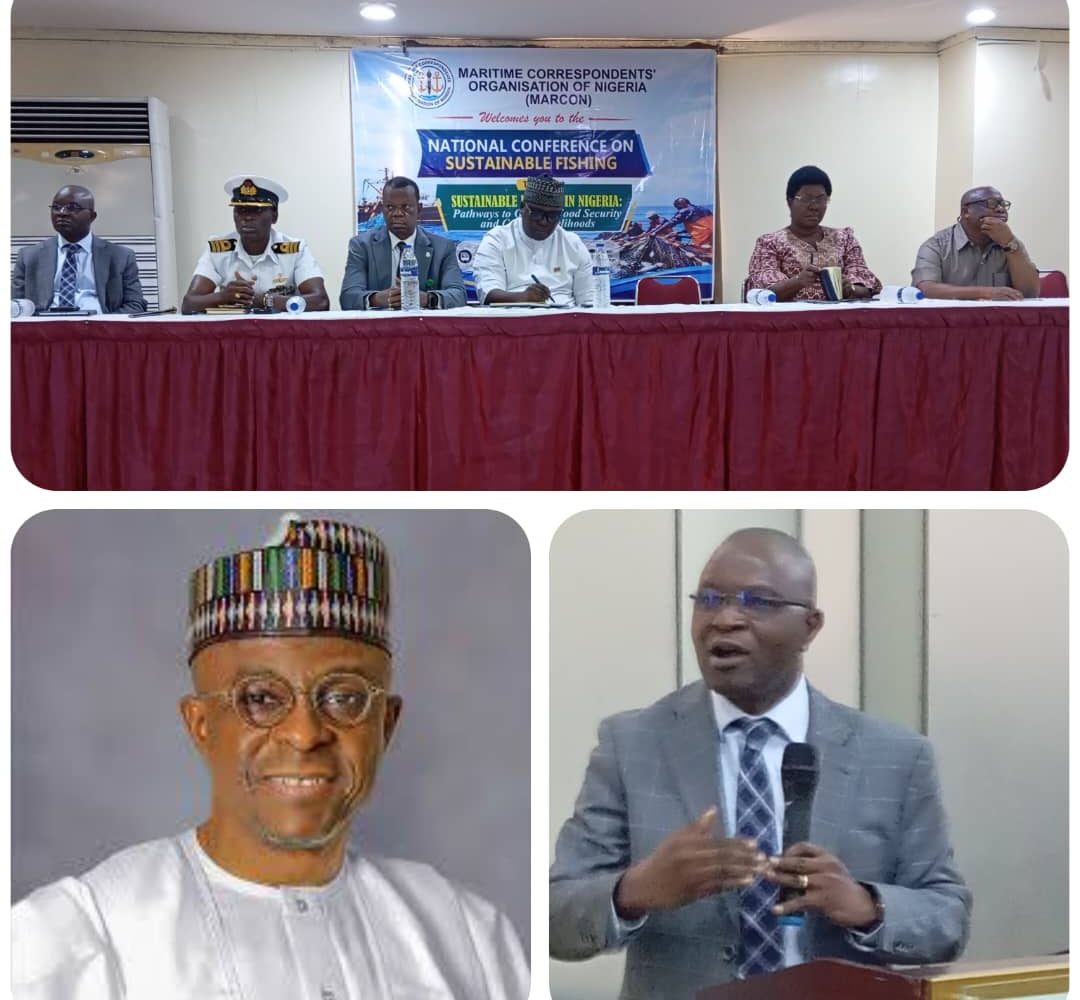
The Nigerian Ports Authority (NPA) has called for the development of dedicated fishing ports and specialised fish terminals as part of efforts to unlock Nigeria’s fisheries potential and strengthen the country’s blue economy.
Managing Director of the NPA, Abubakar Dantsoho, made the call in a presentation delivered on his behalf by Adegbite Adewunmi at the National Conference on Sustainable Fishing organised in Lagos by the Maritime Correspondents Association of Nigeria (MARCON).
Dantsoho said the development of a viable fish economy required investment in core fishing port infrastructure, efficient handling systems and logistics facilities designed specifically for perishable cargo such as fish.
He said the NPA was examining the role of fishing ports, specialised terminals, environmental considerations and efficient port operations in supporting the fisheries value chain.
According to him, ports form an important link in the international logistics chain by providing the pathway through which goods move from producers to consumers.
The NPA boss explained that commercial ports generally perform three major functions: loading and unloading of cargo, transfer of cargo and storage.
Dantsoho noted that commercial ports could either be multipurpose facilities handling different categories of cargo or specialised ports and terminals designed to handle specific commodities.
Using fish as an example, he said Nigeria could develop dedicated fish terminals within its port system, similar to specialised port facilities in some other countries.
He said such terminals could be equipped specifically to handle fish and other seafood, thereby improving efficiency and supporting the development of the fisheries sector.
Infrastructure for Fishing Ports
Dantsoho identified several critical infrastructure requirements for functional fishing ports, including marine structures, cargo-handling facilities, logistics support, cold storage facilities and efficient road connections.
He said breakwaters were particularly important because they help protect harbours from wave action and create safer conditions for vessel and cargo operations.
According to him, breakwaters constitute a significant component of the cost of developing port infrastructure because of the scale of construction required.
He also identified quay infrastructure as essential for fishing ports, providing berthing facilities where trawlers and other fishing vessels can dock for cargo operations and other services.
Other critical infrastructure, he said, includes slipways and shipyards, which allow fishing vessels to undergo maintenance and repairs.
He stressed the importance of navigational channels, noting that although many fishing vessels and trawlers do not have very deep drafts, channels must remain sufficiently navigable to enable vessels to safely enter and leave ports.
Cold Storage, Processing Facilities
The NPA managing director also emphasised the importance of cold-chain infrastructure because fish is a highly perishable commodity.
He said fishing ports should have ice plants, refrigerated storage and other cold-storage facilities capable of maintaining fish at appropriate temperatures from the point of landing until distribution.
“The moment the fish goes bad, there’s no way we can be talking about selling it,” he said, as delivered by Adewunmi.
He also called for the development of processing and packaging facilities within or around fishing terminals.
Such facilities, he explained, would allow fish and other seafood products to be processed, packaged and prepared for domestic distribution or export.
Dantsoho said these facilities represented potential investment opportunities for private-sector operators seeking to participate in the fisheries value chain.
Road Network Critical to Fish Economy
Beyond port infrastructure, he said efficient road logistics were necessary to connect fishing ports with markets and consumers.
He noted that the movement of fish from the port does not mark the end of the logistics chain, stressing that the ultimate objective was to ensure that the commodity reaches the final consumer efficiently and in good condition.
Dantsoho therefore called for an integrated approach to fishing-port development that combines marine infrastructure, specialised terminals, cold-chain systems, processing facilities and efficient road networks.

He said such investments would help reduce losses of perishable fish products, improve the efficiency of the fisheries value chain and contribute to the development of Nigeria’s blue economy.




Comment here