


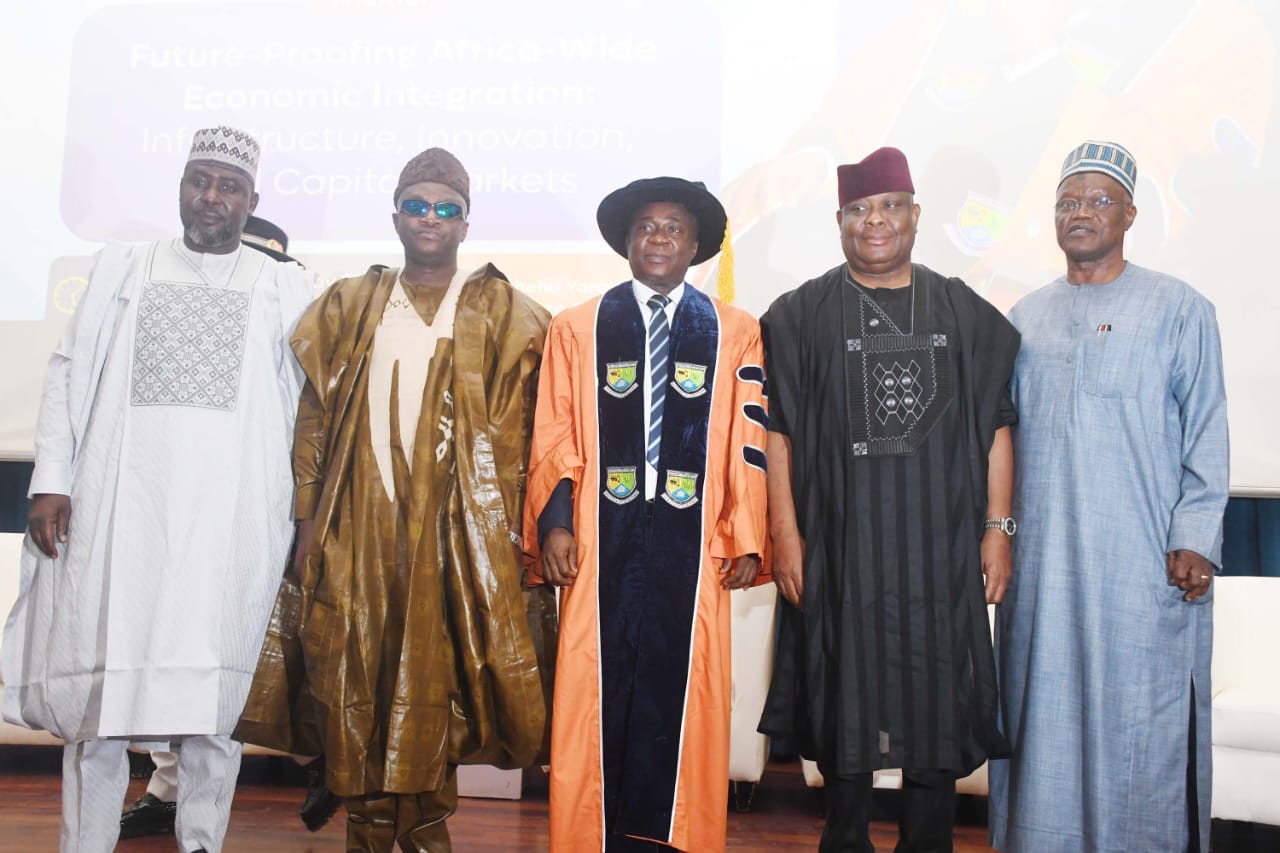
Policymakers, academics, regulators, legislators and capital market operators have called for stronger macroeconomic coordination, harmonised regulations and innovative infrastructure financing to accelerate Africa’s economic integration.
The call was made at the third edition of the Prof. Uche Uwaleke (PUU) Biennial Capital Market Colloquium, held on Monday at the Yar’Adua Centre in Abuja.
Themed “Future-Proofing Africa-wide Economic Integration: Infrastructure, Innovation, and Capital Markets,” the event brought together leading voices from government, academia and industry to chart a sustainable path for continental growth.
The colloquium, organised in honour of Professor Uche Uwaleke, Director of the Institute of Capital Market Studies at Nasarawa State University, Keffi, focused on how infrastructure development, technological innovation and resilient capital markets can collectively drive Africa’s integration agenda.
Participants acknowledged the transformative potential of the African Continental Free Trade Area (AfCFTA) in boosting intra-African trade, deepening industrialisation and catalysing cross-border investment flows.
However, they stressed that beyond signing agreements, effective implementation, regulatory alignment and macroeconomic stability are critical to achieving tangible results.
Macroeconomic Stability and Infrastructure Financing
Deliberations underscored macroeconomic convergence – anchored on price stability, fiscal discipline, exchange rate predictability and credible monetary policy frameworks – as the foundation for sustainable integration.
Without stability, participants warned, long-term infrastructure financing and cross-border capital mobility would remain exposed to shocks.
Infrastructure investment was identified as the backbone of integration, with emphasis on coordinated spending in transport networks, energy systems and digital infrastructure.
Energy security, in particular, was described as central to industrialisation and regional competitiveness.
Blended finance models, infrastructure bonds and public-private partnerships were recommended as viable funding options.
Trade Barriers and Global Alignment
While acknowledging the AfCFTA’s legal framework, stakeholders pointed to persistent non-tariff barriers, customs inefficiencies and fragmented standards as obstacles to intra-African trade.
They called for improved trade facilitation systems and closer alignment with global obligations under the World Trade Organization.
Capital Market Integration and Financial Integrity
The colloquium emphasised the need for interoperable settlement systems, harmonised listing requirements and coordinated regulatory oversight across African exchanges to enable seamless cross-border trading and investment.
Operational infrastructure—such as registrars, clearing houses, custodians and digital shareholder services—must also be technologically integrated, participants noted.
On financial reporting, the forum highlighted the importance of accounting harmonisation and ethical standards to sustain investor confidence.
Professional bodies, including the Institute of Chartered Accountants of Nigeria, were encouraged to strengthen collaboration with counterparts across the continent.
Fintech, CBDCs and Human Capital
Participants advocated enabling legislation to support fintech innovation, digital identity systems, robust data governance frameworks and cybersecurity standards. Regulatory sandboxes were recommended to balance innovation with consumer protection.
The potential of Central Bank Digital Currencies (CBDCs), including Nigeria’s eNaira, to facilitate faster and more transparent cross-border payments was acknowledged.
However, experts cautioned that interoperability, cybersecurity resilience and public trust would determine whether CBDCs enhance or fragment African markets.
The forum also urged African universities to redesign curricula to reflect regional economic realities and promote cross-border research collaboration, stressing that human capital development is vital to long-term integration success.
Resolutions
At the close of deliberations, the colloquium resolved to advocate stronger macroeconomic coordination among African countries, promote harmonisation of capital market regulations, eliminate non-tariff barriers and accelerate AfCFTA implementation.
It also pledged support for innovative infrastructure financing instruments, including green and diaspora bonds; deeper collaboration among accounting and regulatory bodies; stronger academia-industry-government partnerships; and legislative frameworks that encourage responsible fintech innovation while safeguarding investors.
In his remarks, Professor Uche Uwaleke reaffirmed the need for deliberate, coordinated and future-oriented integration across the continent, stressing that infrastructure must connect markets physically and digitally, innovation must unlock productivity, and capital markets must mobilise long-term savings into transformative investments.

L-R: Senator Aminu Abbas (Chairman Senate Committee on Science & Technology); Prof Kitso Ngarubi (Deputy Vice Chancellor Nasarawa State University Keffi; Prof Uche Uwaleke (Prof of Capital Market and Honoree); Senator Osita Izunaso (Chairman Senate Committee on Capital Market), and Senator Peter Jiya (Vice Chairman, Senate Committee on Capital Market) at the Prof Uche Uwaleke (PUU) Colloquium on Capital Market held on Monday February 23rd at the Yaradua Centre Abuja.
He expressed optimism that a fully integrated African economic space is achievable if institutions are strengthened, policies harmonised and political commitment sustained.





Comment here