


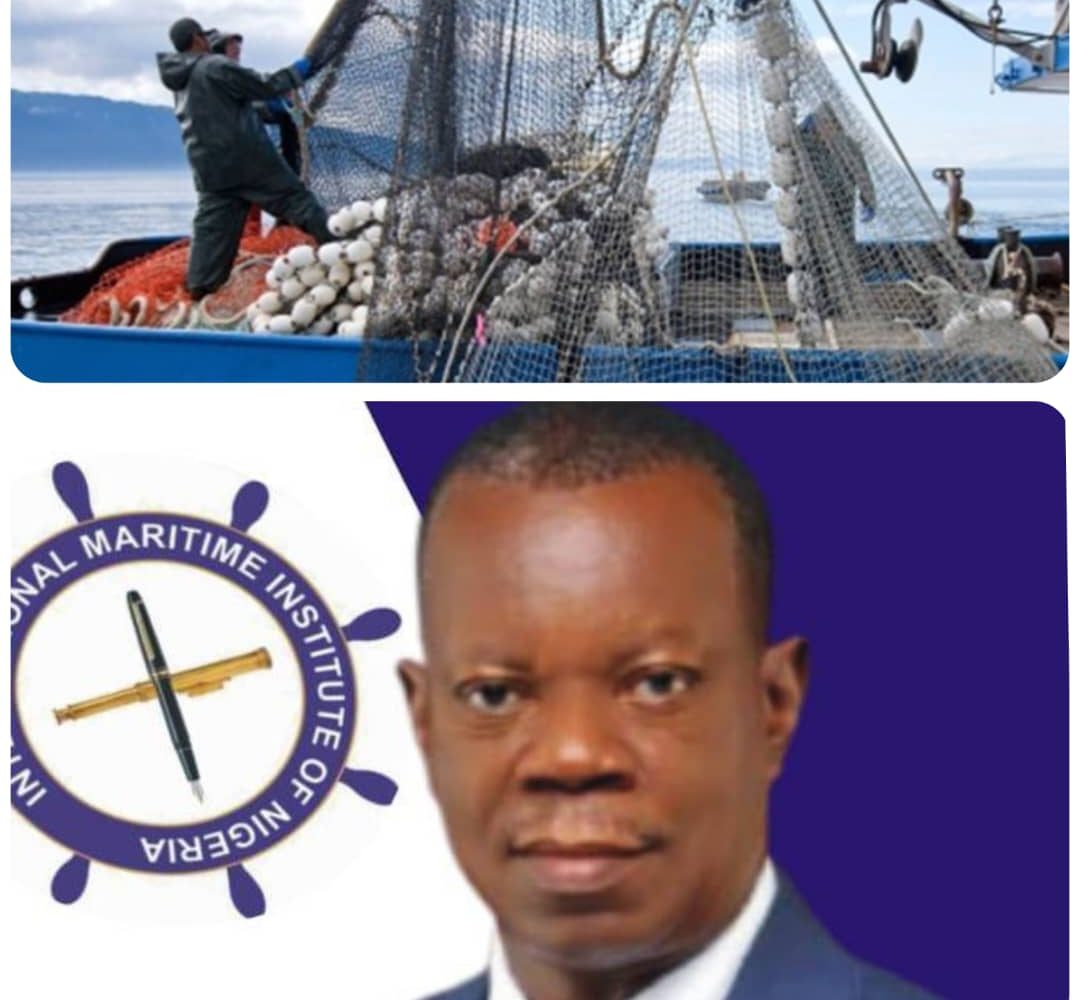
Nigeria’s continued dependence on seafood imports despite its vast fisheries resources poses a major challenge to food security, coastal livelihoods and economic development, Director General of the International Maritime Institute of Nigeria (IMION), Rear Admiral (Rtd.) Thaddeus Udofia, has said.
Udofia made the observation at the Maritime Correspondents of Nigeria, MARCON 2026 National Conference on Sustainable Fishing, themed “Sustainable Fishing in Nigeria: ”Pathways to Growth, Food Security and Coastal Livelihoods.”
He said Nigeria was endowed with extensive marine and inland water resources capable of supporting food production, employment and economic growth, but the country had yet to fully harness the potential of its fisheries sector.
According to him, Nigeria’s maritime domain includes an extensive coastline, its 200-nautical-mile Exclusive Economic Zone (EEZ), inland waterways, creeks, estuaries and the Niger Delta Basin, all of which possess significant fisheries and aquaculture potential.
However, Udofia said the sector had suffered from underinvestment, weak management and unsustainable exploitation over the years.
He cited data attributed to the United Nations Commodity Trade Statistics Database (UN Comtrade), saying Nigeria’s imports of frozen fish and seafood rose from $606 million in 2023 to $688.5 million in 2024, with a further increase recorded in 2025.
He described the situation as a paradox, given Nigeria’s abundant aquatic resources and the growing demand for seafood from its large and youthful population.
Udofia identified overfishing, climate change and illegal, unreported and unregulated (IUU) fishing as major threats to the sustainability of Nigeria’s fisheries.
He warned that illegal fishing activities within Nigeria’s maritime domain were depleting fish stocks, while destructive fishing practices were damaging marine habitats and undermining the livelihoods of artisanal fishermen.
“When the local fisherman in Ondo, for instance, ventures out to sea and returns with an empty canoe, that is not simply a bad day at work. That is a direct challenge to Nigeria’s national security,” he said.
Five-Pillar Framework
To address the challenges, Udofia advocated a strategic framework centred on stronger regulation and enforcement, sustainable resource management, technology and data intelligence, institutional collaboration and community-based fisheries management.
He stressed the importance of using modern maritime technology, including satellite surveillance, spatial monitoring and data analysis, to improve the management of Nigeria’s fisheries resources.
“We cannot effectively manage what we do not accurately measure,” he said.
He also called for stricter monitoring of industrial fishing activities and effective catch-control measures to ensure that fish stocks and marine habitats have sufficient time to regenerate.
On community participation, Udofia said coastal communities should be given a greater role in managing and protecting local fishing grounds.
“We cannot achieve sustainable fishing through rigid top-down enforcement alone without community-driven initiatives,” he said.
He proposed empowering local cooperative societies and giving communities legitimate co-management responsibilities over fishing grounds.
Youth Development
Udofia further advocated greater investment in skills development for young people in coastal communities.
He said IMION was exploring capacity-building programmes that would equip coastal youths not only for fishing but also for opportunities as marine entrepreneurs, ecosystem conservationists, tour guides, boat builders and specialised technicians.
According to him, diversifying coastal livelihoods would help reduce pressure on wild fish stocks while creating additional sources of income for households.
He urged the government, financial institutions, regulators, academia and maritime organisations to work together to develop the fisheries sector.
Udofia called on academia to provide actionable research, financial institutions to develop tailored credit facilities for artisanal fishing cooperatives and regulators to enforce fisheries laws effectively.
He said institutions such as IMION had a role to play in strengthening research, human-capacity development and governance frameworks for sustainable fishing.
The IMION DG urged stakeholders to move beyond conference resolutions and implement concrete measures capable of transforming Nigeria’s fisheries into a sustainable driver of economic growth, food security and coastal livelihoods.
“Let us protect our waters and beaches, our resources, and very soon protect our future,” Udofia said.




Comment here