


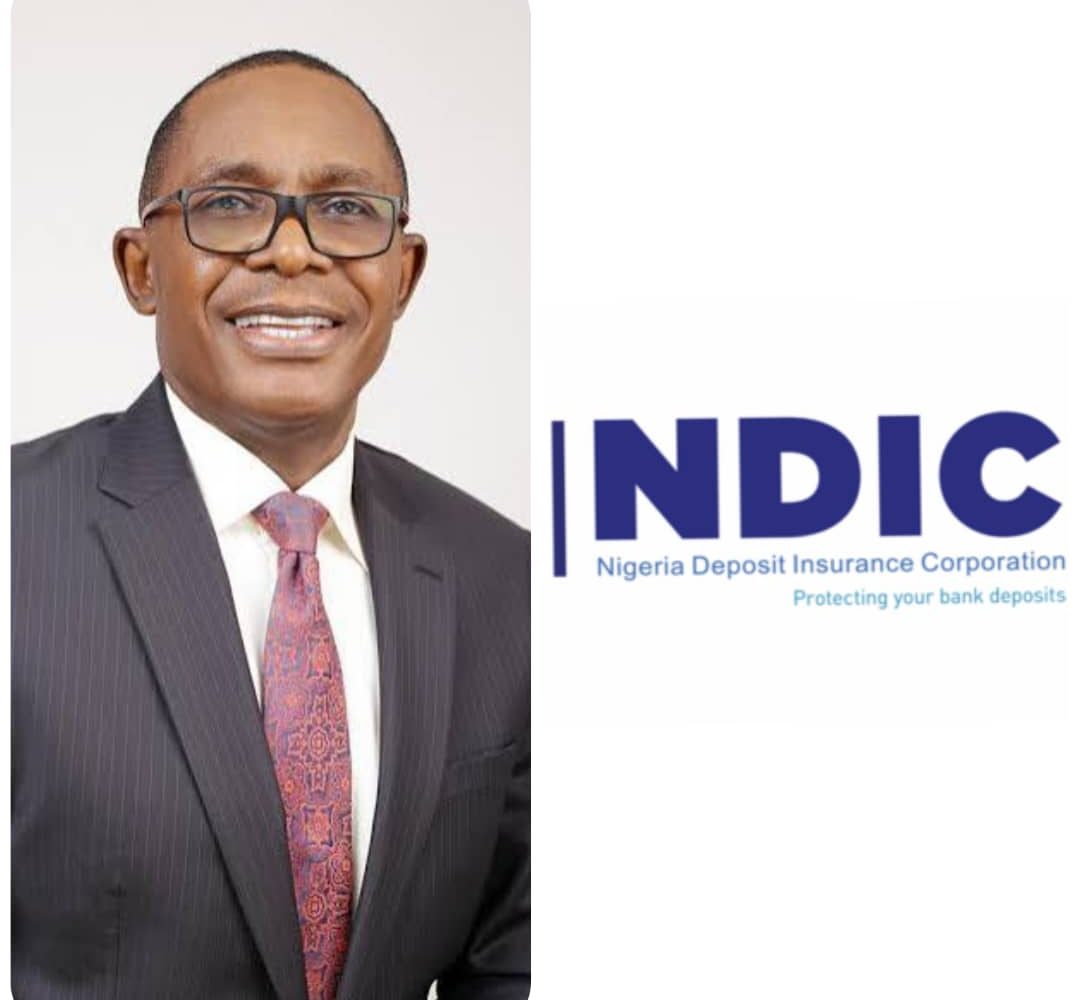
The Nigeria Deposit Insurance Corporation (NDIC) has urged Nigerians to keep their money in licensed and regulated financial institutions, warning against the risks associated with unregulated investment schemes and Ponzi schemes.
The Managing Director/Chief Executive of the NDIC, Mr Thompson Oludare Sunday, gave the warning on Wednesday while delivering the keynote address at the Corporation’s Special Day at the 21st Abuja International Trade Fair, organised by the Abuja Chamber of Commerce, Industry, Mines and Agriculture.
Sunday said the warning was necessary as some Nigerians still keep substantial funds outside the formal banking system or entrust their savings to unlicensed fund managers attracted by promises of extraordinary returns.
He said the collapse of Ponzi schemes had repeatedly demonstrated the financial and emotional consequences of placing hard-earned resources in unregulated schemes.
“If an investment promise sounds too good to be true, Nigerians should pause, ask questions and verify before committing their money,” he said.
The NDIC boss said the Corporation remained a critical pillar of Nigeria’s financial safety-net architecture, with responsibilities covering deposit guarantee, bank supervision in collaboration with the Central Bank of Nigeria (CBN), failure resolution and bank liquidation.
According to him, these functions are critical to economic resilience because businesses require a trusted financial system to safeguard working capital, facilitate payments and support access to credit for investment and expansion.
He disclosed that the NDIC enhanced deposit insurance coverage in 2024, raising the maximum insured limit to ₦5 million per depositor per Deposit Money Bank (DMB) and Mobile Money Operator (MMO), while depositors in Microfinance Banks (MFBs), Primary Mortgage Banks (PMBs) and Payment Service Banks (PSBs) enjoy coverage of up to ₦2 million.
The enhanced limits, he said, provide full coverage for more than 98 per cent of depositors across insured institutions, thereby protecting households, small businesses and other vulnerable depositors from the immediate consequences of bank failure.
Sunday added that depositors whose balances exceed the insured limits could receive liquidation dividends from recoveries made through debts owed to failed institutions and the disposal of their physical assets.
He said the NDIC had also transformed its reimbursement process through the deployment of technology, including Bank Verification Number (BVN), Single Customer View (SCV), NIBSS infrastructure and other digital solutions.
“Today, verified depositors of failed banks receive their insured deposits within days of bank closure,” he said.
According to him, the NDIC is repositioning itself from merely paying claims after bank failures to becoming a “Risk Minimizer” by identifying vulnerabilities early, strengthening safeguards and preventing institutional problems from escalating into systemic crises.
He said the Corporation had strengthened its institutional framework through initiatives including Risk-Based Supervision, an enhanced Differential Premium Assessment System, the Single Customer View Framework, distress resolution tools and the Bank Liquidation Management System.
The NDIC is also strengthening collaboration with the CBN and other members of the financial safety-net architecture, he added.
On digital access to NDIC services, Sunday disclosed that the Corporation launched an upgraded website on September 19, 2026, designed as a one-stop digital gateway for depositors and other stakeholders.
He said the website provides information on deposit insurance coverage, automated claims-processing features and a directory for verifying NDIC-insured institutions.
It also provides direct access to key services, including filing claims, checking banks, reporting failed banks and accessing frequently asked questions, while an AI-powered virtual assistant has been incorporated to improve user interaction.
Sunday urged depositors, creditors and shareholders of closed banks to make use of the Corporation’s digital platforms when processing their claims.
He also advised depositors to ensure that their account information is accurate and consistent across banks and properly linked to their BVNs to facilitate faster reimbursement.
He stressed that technology and regulation alone could not guarantee financial security, noting that financial literacy remained the first line of defence for depositors and business owners.
The NDIC chief executive urged businesses and members of the public to strengthen their financial literacy, use digital financial services responsibly, maintain sound financial practices and seek guidance from relevant regulatory institutions when necessary.
The 21st Abuja International Trade Fair is themed “Resilience: Trade, Taxation and the Economy.”
Sunday said the theme was particularly relevant to Nigeria’s ongoing economic reforms and efforts to build a stronger, more resilient and productive economy in line with the Federal Government’s vision of a $1 trillion economy by 2030.
He also commended the Abuja Chamber of Commerce, Industry, Mines and Agriculture for sustaining the trade fair for 21 consecutive years.




Comment here