


By Ummie Kabir
Every morning, importers in Alaba, Idumota, and Onitsha markets face the same arithmetic. Goods made in Guangzhou or Yiwu must be paid for in dollars, and dollars must be bought at a price that moves with the vagaries of the foreign exchange market.
A cost that should be simple becomes a gamble. That daily gamble helps explain why the latest moves by the Central Bank of Nigeria (CBN) with Chinese financial institutions matter far beyond the boardroom.
Governor Olayemi Cardoso has said Nigeria will push for stronger cross-border payment arrangements with China on an upcoming visit to Beijing, after meeting Pan Gongsheng, governor of the People’s Bank of China. Their talks covered cross-border payments, settlement arrangements, financial technology and trade finance.
Chinese lenders, including the Industrial and Commercial Bank of China (ICBC), are part of the wider conversation on deepening financial flows and naira-denominated investment instruments. The technical details have not been made public.
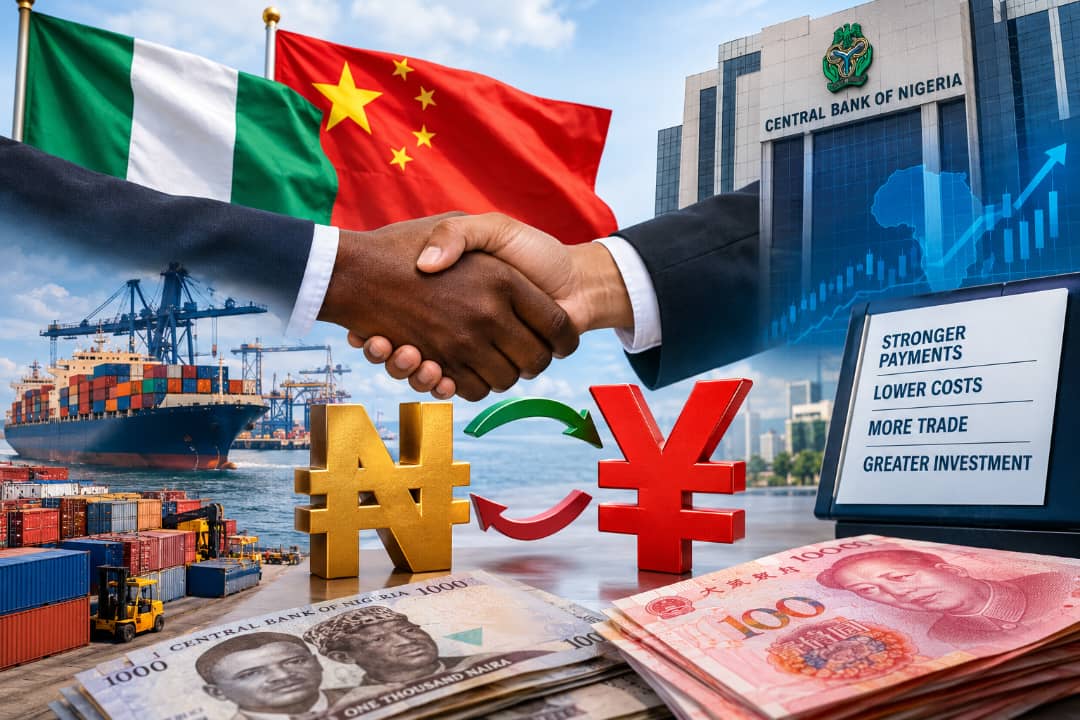
The idea is not new but an old one now with sharper edge. In 2016, the CBN and ICBC, the world’s biggest lender, signed an agreement on Yuan transactions which the officials said a currency swap would help settle trade deals in Yuan.
A swap line between the two central banks followed in 2018. What has now changed is the urgency. Nigeria has spent the past three years restructuring its foreign exchange market, rebuilding reserves and trying to restore investor confidence.
A settlement channel that reduces dependence on a single foreign currency now looks like a practical tool of policy, beyond mere diplomatic gesture.
For Nigeria, the first prize is cheaper, steadier trade settlement. Better financial connectivity with China could help businesses manage import payments, settle commercial obligations and facilitate investment.
If a Nigerian trader can pay a Chinese supplier through a direct naira-yuan route, the dollar-conversion step, with its spread and its delays, shrinks or disappears. Small and medium-sized enterprises, which cannot absorb currency shocks the way large corporations can, would benefit most.
The second is relief for dollar demand.China is among Nigeria’s largest sources of imports, and every transaction that does not need a dollar eases pressure on the foreign exchange market and, ultimately, on the Naira.
Also, Naira-denominated investment instruments could open a channel for Chinese institutional money into Nigerian assets in the form of new capital. Nigeria needs long-term capital for power, rail, roads, ports and manufacturing at this point in time.
On the part of Beijing, the interest is no less real. Years of effort to widen the international use of the Yuan depend on finding partners who will actually use it.
Africa’s most populous nation, with a large consumer market and a deep appetite for Chinese goods, is a natural candidate. Each trade settled in yuan strengthens the currency’s standing as an alternative to the dollar.
Chinese exporters also gain from certainty. When Nigerian buyers struggle to find dollars, orders are delayed or cancelled. A dependable local-currency channel reduces payment risk and keeps goods moving. For Chinese banks like ICBC, a deeper Nigerian presence means new business in trade finance, project lending and treasury services across Africa’s largest economy by population.
There is a strategic dimension too. Nigeria offers a gateway to West African markets, and a working naira-yuan arrangement could serve as a template for other African economies.
However, not everyone will cheer this new development. Some analysts opined that a swap line is only as useful as the trade volumes that flow through it, and Nigeria’s deficit with China means Yuan obligations will accumulate unless exports grow. Nigeria sells to China mostly crude oil and a narrow range of commodities, so closing that gap will take more than financial joggling.
There is also the question of existing sovereign debt. Nigeria’s existing obligations to Chinese lenders are significant, and any new instrument must be structured transparently so that it does not add to pressures on public finances.
The CBN has said it will keep its focus on price stability and monetary discipline, with single-digit inflation remaining its medium-term objective, which suggests that the arrangement will be judged against that yardstick.
As it stands, the Beijing talks are part of a wider pivot. Nigeria’s delegation also engaged the Monetary Authority of Singapore as part of efforts to deepen financial ties with Asian markets. Abuja appears intent on diversifying its financial relationships rather than relying on any single partner.
For the Lagos importer counting the cost of each shipment, the success of these discussions will not be measured in communiqués. It will be measured in whether paying for goods becomes faster, cheaper and less of a gamble.




Comment here