


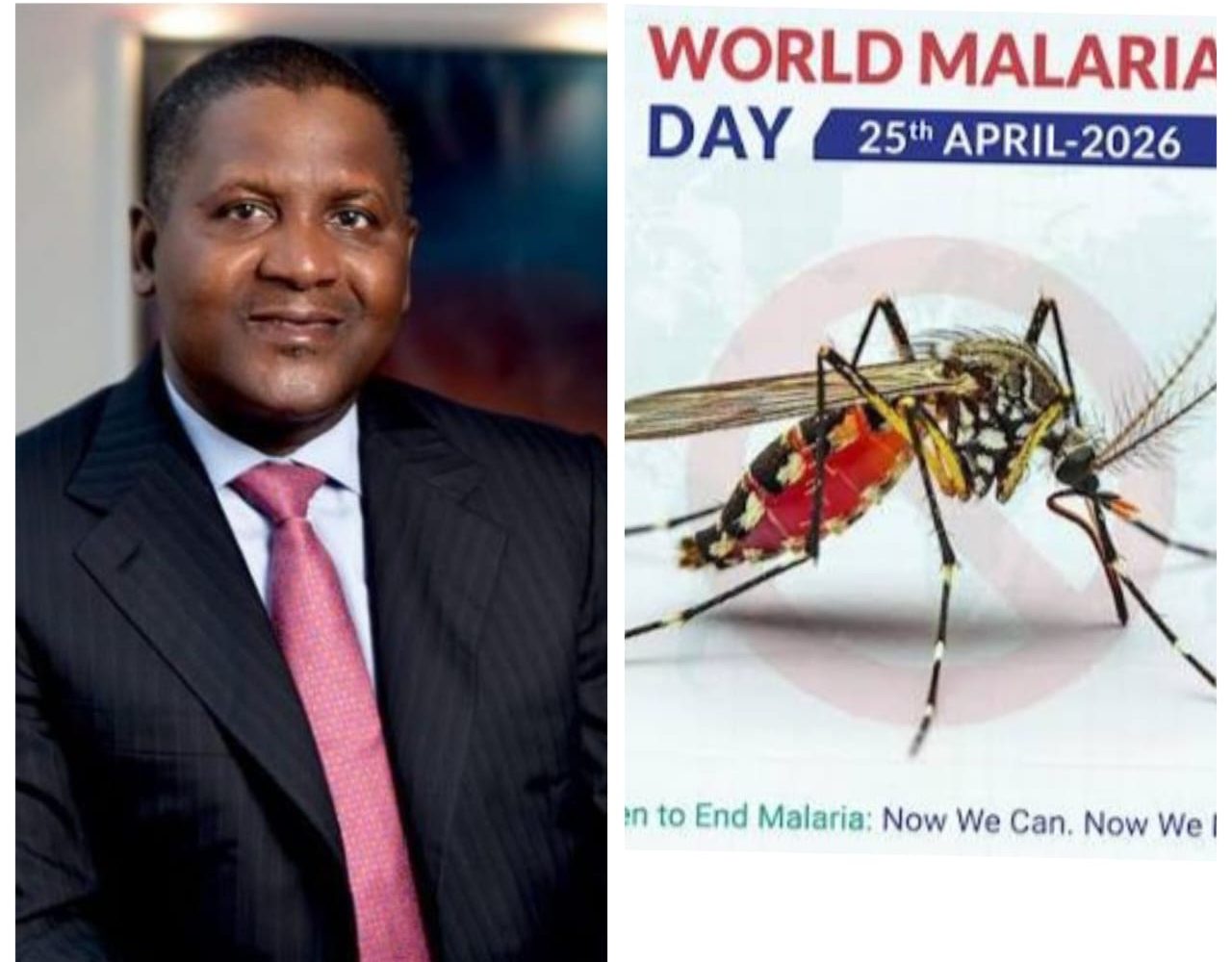
Aliko Dangote, Chairman of Nigeria’s National Malaria Elimination Council (NMEC) and United Nations Malaria Ambassador, has called for urgent and coordinated action by governments and the private sector to eliminate malaria, describing the current moment as critical in the global fight against the disease.
Speaking to mark World Malaria Day 2026, Dangote acknowledged progress in malaria control but warned that gains remain uneven, particularly in sub-Saharan Africa, which continues to account for more than 90 percent of the global disease burden.
He noted that despite advances in prevention and treatment, malaria remains one of the world’s deadliest diseases, disproportionately affecting children under five, pregnant women, displaced populations, and underserved communities.
The disease continues to place significant strain on health systems, economies, and livelihoods across the region.
“Progress against malaria is real, but it remains deeply unequal,” Dangote said, stressing that millions still lack access to life-saving prevention, diagnosis, and treatment.
Dangote described the global malaria response as being at a pivotal stage, supported by scientific breakthroughs, improved healthcare tools, and strengthened partnerships.
He highlighted innovations such as next-generation vaccines, improved diagnostics, and data-driven surveillance systems as key developments that have made malaria elimination more achievable than ever.
According to him, the focus must now shift to large-scale, equitable implementation of these tools.
Referencing this year’s theme, “Driven to end malaria: now we can. Now we must,” Dangote underscored the urgency of collective action and the need for stronger private sector involvement. He noted that companies, including Dangote Industries Limited, are already contributing through workplace and community-based programmes focused on prevention, early diagnosis, and treatment.
He added that well-coordinated private sector initiatives can significantly strengthen national malaria control programmes and deliver measurable impact.
Dangote emphasised that eliminating malaria requires collaboration across all sectors, including governments, businesses, development partners, civil society, and local communities. He called for strengthened public-private partnerships to mobilise resources, drive innovation, and scale interventions.
He also warned of emerging challenges such as drug and insecticide resistance, urging sustained investment in research and adaptive strategies to safeguard existing progress.
“The path to a malaria-free world is clear. We have the tools. We have the knowledge,” he said. “What we need now is urgency, sustained investment, and collective accountability.”
Dangote urged governments to maintain policy momentum and funding commitments, called on the private sector to expand proven interventions, and encouraged development partners to continue supporting high-burden countries.
“Together—driven by purpose and united in action—we can end malaria,” he said. “Now we can. Now we must.”




Comment here