


By Barnabas Esiet.
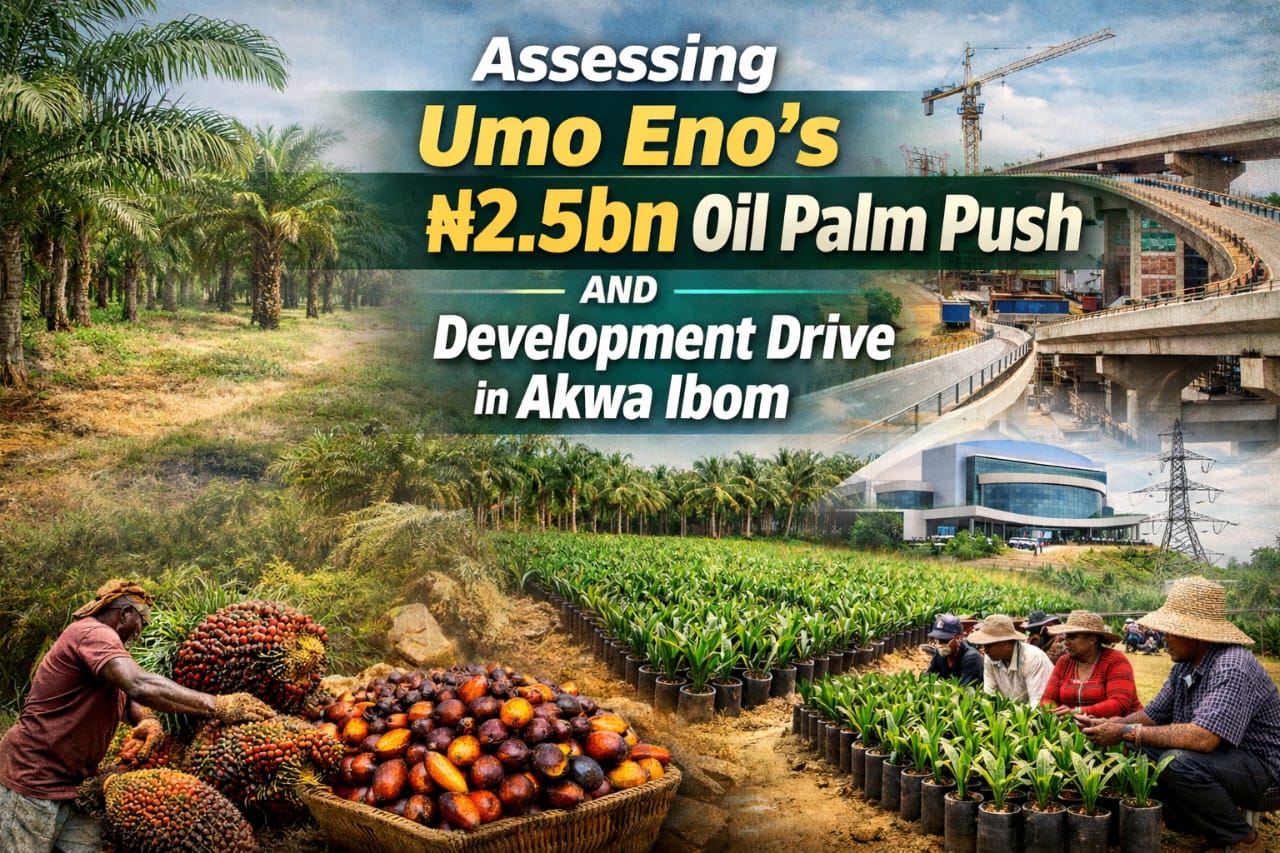
Governor Umo Eno’s approval of a ₦2.5 billion investment in oil palm development marks a significant policy move aimed at repositioning Akwa Ibom State’s economy, but its long-term success will depend on effective implementation, transparency, and sustained support for farmers.
The initiative, which provides for the procurement and distribution of over 620,000 palm seedlings across all 31 local government areas, reflects a strategic attempt to revive agriculture as a major economic driver.
By focusing on oil palm—a crop with strong domestic and export value—the administration appears to be aligning with broader national goals of agro-industrial growth and reduced reliance on oil revenues.
From a policy perspective, the intervention is well-targeted. Oil palm production has historically been a strength in southern Nigeria, and scaling up cultivation could stimulate rural economies, create jobs, and deepen participation in the agricultural value chain.
The emphasis on involving registered farmers suggests an effort to ensure structure and accountability, although questions remain about how inclusive and transparent the distribution process will be.
Governor Eno’s framing of the programme as part of a wider economic diversification agenda is also noteworthy. Like many subnational governments, Akwa Ibom faces fiscal pressures tied to fluctuations in federal allocations.
Investing in agriculture offers a viable pathway to build internal revenue, but the challenge lies in moving beyond primary production to processing, marketing, and export competitiveness.
The review of 55 strategic projects during the March Projects Delivery Meeting adds another layer to the administration’s development narrative.
Key assets such as the Ibom International Convention Centre, Ibom International Hotel, and the Itam Industrial Park have long been seen as potential economic catalysts, yet their impact has often been constrained by underutilisation and delayed completion. Setting firm timelines for delivery is a positive step, but credibility will depend on adherence to those timelines.
Similarly, ongoing investments in healthcare, housing, and tourism – including the 350-bed International Hospital and the Arise Palm Resort – indicate a broad-based development approach.
However, the simultaneous pursuit of numerous capital-intensive projects raises concerns about prioritisation, funding sustainability, and maintenance capacity.
In the power sector, the governor’s acknowledgment of nationwide generation challenges and his administration’s ambition to take greater control of the state’s electricity market reflects a proactive stance.
If successfully executed, improved power supply could significantly enhance industrial productivity and attract investment. Yet, this remains an area where policy intentions often face regulatory and structural hurdles.
The reported completion of 10 roads covering 58.5 kilometres, contributing to a wider network of over 1,300 kilometres, underscores ongoing infrastructure expansion.
While road development is essential for economic integration, the real test will be in the quality of construction and the extent to which these roads facilitate commerce and mobility.
Overall, the administration’s efforts under the ARISE Agenda present a comprehensive vision for economic growth and improved living standards.
The oil palm investment stands out as a potentially impactful initiative, but like many government programmes, its effectiveness will ultimately be judged not by announcements, but by measurable outcomes- higher yields, increased incomes, job creation, and sustained economic activity across the state.





Comment here