


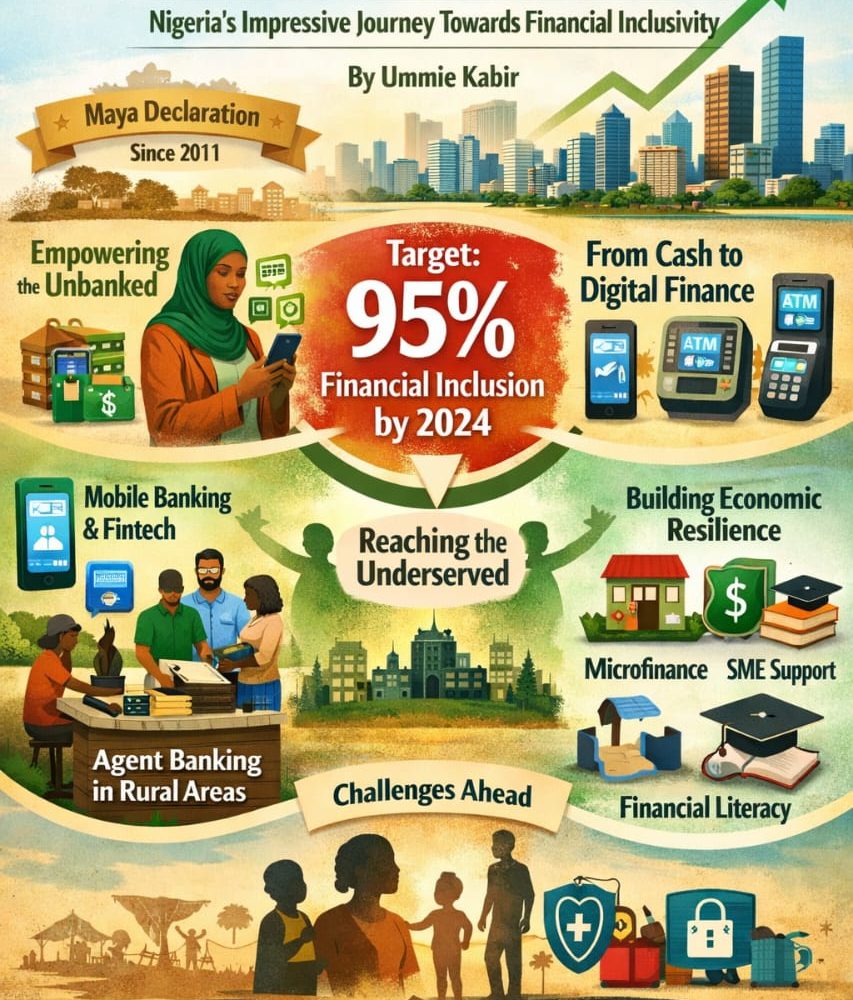
By Ummie Kabir.
Nigeria joined several other countries in Mexico, precisely in the city of Riviera Maya, in September 2011 for the Third Alliance for Financial Inclusion (AFI) and subscribed to the now famous Maya Declaration
That particular gathering marked the first deliberate effort to establish a global and measurable set of commitments by developing countries regulators to reduce poverty through increased financial access.
The goal was unequivocally set to empower individuals, especially the poor, through financial inclusion, while enhancing national financial stability. And this has thus far achieved several set targets overwhelmingly as of 2025 in several countries, Nigeria inclusive.
The declaration not only attracted attention globally, even the World Bank endorsed the initiative and redefined financial inclusion to mean “individuals and businesses have access to useful and affordable financial products and services—transactions, payments, savings, credit, and insurance—that meet their needs and are delivered in a responsible and sustainable way.” Describing it as a key enabler for reducing poverty and boosting prosperity.
The World Bank went steps further to set up key performance indicators for assessing the state of financial inclusion through the Global Findex Database. This was being done by measuring access to and usage of financial services across three key dimensions namely availability, usage, and quality to boost development and poverty reduction.
A much needed Strategic Support was also consummated via initiatives like the Financial Inclusion Support Framework (FISF), through which the Bank provides technical assistance, data, and funding to help countries build inclusive financial systems. The results indicate significant Global account ownership has recorded significant growth from 55 percent in 2014 to over 70 percent in 2021.
Coming down home, the Central Bank of Nigeria (CBN) defines financial inclusion as the state when adult Nigerians have easy access to a broad range of formal financial services that meet their needs at an affordable cost. This includes access to payments, savings, credit, insurance, and pensions for all income segments.
The Central Bank of Nigeria joined the global network of policy makers to commit to and sign the ”Maya Declaration” in 2010, to reduce financial exclusion in Nigeria to 20% by the year 2020.
This commitment led to a National Financial Inclusion Strategy in 2012, with the aim of achieving adult financial inclusion of 80% by 2020. The baseline of financial exclusion as at 2012 stood at 46.3%.
At the point of conception of the NFIS, the baseline for Payments was 21.6%, Savings (22.4%), Credit (1.8%), Insurance (1.0%) and Pensions (5.0%). In addition, actual DMB branches by 2010 stood at (6.8 per 100k population), MFB branches (2.9), ATMs (11.8), POS Devices (13.3) and Mobile Agents (0.0).
The CBN has since taken the baton in the race to totally eliminate or reduce the exclusion rate to the bearest minimum and possibly meet the targets among peers. The Bank aims to achieve 95% total financial inclusion, with focus on reducing exclusion from 35.9% (in 2020) to 5%. Key strategies include driving digital payments, mobile money and agent banking to reach underserved populations, targeting 75% formal financial inclusion.q
In order to achieve the targets , CBN came up with The National Financial Inclusion Strategy (NFIS) aimed at enhancing access to payments, savings, credit, insurance, and pensions, with a focus on narrowing gender and regional gaps. This is in addition to the promotion of agent banking, mobile money, and POS terminals to connect the unbanked, particularly in rural areas.
Another novel strategy to drive financial inclusion was adopted by the apex bank is the digitalization of the payment system The bank drives financial inclusion through digital payments, encouraging the use of financial technology to enhance access.
This has led to 74 percent inclusion rate as at 2024. The bank has continued to implement policies supporting microfinance efficiency, consumer protection, and financial literacy to ensure that financial services are affordable and accessible to more Nigerians.
The story of financial inclusion in Nigeria will be incomplete without the credible roles being played by Enhancing Financial Innovation and Access (EFInA) as a critical financial sector development partner.
Established in 2007 to promote pro-poor financial inclusion, drive systemic change through data-driven research, advocacy, and innovation funding, aiming to increase access to financial services for underserved, unbanked, and low-income populations.
EFInA has been playing critical roles in Nigeria financial ecosystem which include evidence-based research which serves as the primary source of data on financial inclusion in Nigeria.
Another major initiative of EFInA is Innovation Fund to Catalyzes the development of new, accessible financial products and business models for the unbanked and under-banked through its Innovation Fund.
This is in addition to the provision of technical support for Policy Advocacy and Frameworks by collaborating with the CBN in the implementation the National Financial Inclusion Strategy, providing critical input on frameworks, especially regarding women’s financial inclusion.
In short, EFInA’s work directly contributes to the national goal of achieving 95% financial inclusion by 2024, focusing on improving the financial health of Nigerians.
Digital financial services (DFS) have evolved in the last two decades to provide easier access to financial services that were previously offered to a specific group of individuals and businesses.
By leveraging on technology and data, digital finance ensures that a much larger proportion of Nigerians have easier access to several products and services including credit options, investment opportunities, insurance, savings, and retirement plans, amongst many others.
These are rendered through a variety of channels including, mobile phones, point-of-sale devices and networks of agents, thus improving business transactions and practices in the country and leading towards a truly cashless economy.
The rapid growth of the digital financial ecosystem is enormous as studies have shown that FinTech firms constitute over 50.0 per cent of the number of financial services providers in the Nigerian financial system.
The quest for financial services driven by digital technology has continued to soar. Fintech has evolved as a transformative force in promoting financial inclusion by enhancing access, affordability, and literacy in financial services.
The role of fintech in bridging financial gaps, particularly for underserved and rural populations has demonstrated fintech’s capacity to lower barriers for disadvantaged groups, promote equitable economic participation, and support sustainable development goals.
The success story of financial inclusion in Nigeria cannot be adequately reviewed without highlighting the challenges inhibiting desire to deepen financial inclusivity.
Several studies have revealed the vulnerability of some critical segments of the society in the financial inclusion drive especially in developing country like Nigeria where Poor people, children, women, youth and rural people are mostly exposed during financial, economic and environmental crises.
They lack most of the basic buffers against shocks such as savings, insurance, credit and pensions, hence they are overexposed to shocks from systemic turbulence. These are attributable to lower and irregular income, exorbitant cost of access financial services.
Financial inclusion drive largely depends on digital services as such, risks of fraud and data misuse often frighten users, particularly those with low digital literacy and cybersecurity risks remain critical barriers as such, collaboration between apex bank, financial institutions, and fintech companies are essential to strengthen digital infrastructure, enhance financial education and ensure safe, inclusive access to financial services.
Next steps for financial inclusion in Nigeria should focus on accelerating digital adoption,financial literacy, expanding rural agent networks, and enhancing consumer protection to bridge the gender and regional divide.
Key actions include upgrading digital infrastructure to support massive deployment of tools like Point of Sale (POS) service delivery, implementing simplified Know Your Customert (KYC), and fostering collaboration across sectors to drive financial literacy, particularly in the rural areas.
These initiatives would transform from mere access to active usage of financial products, thereby driving deeper, more meaningful inclusion towards economic resilience.





Comment here