


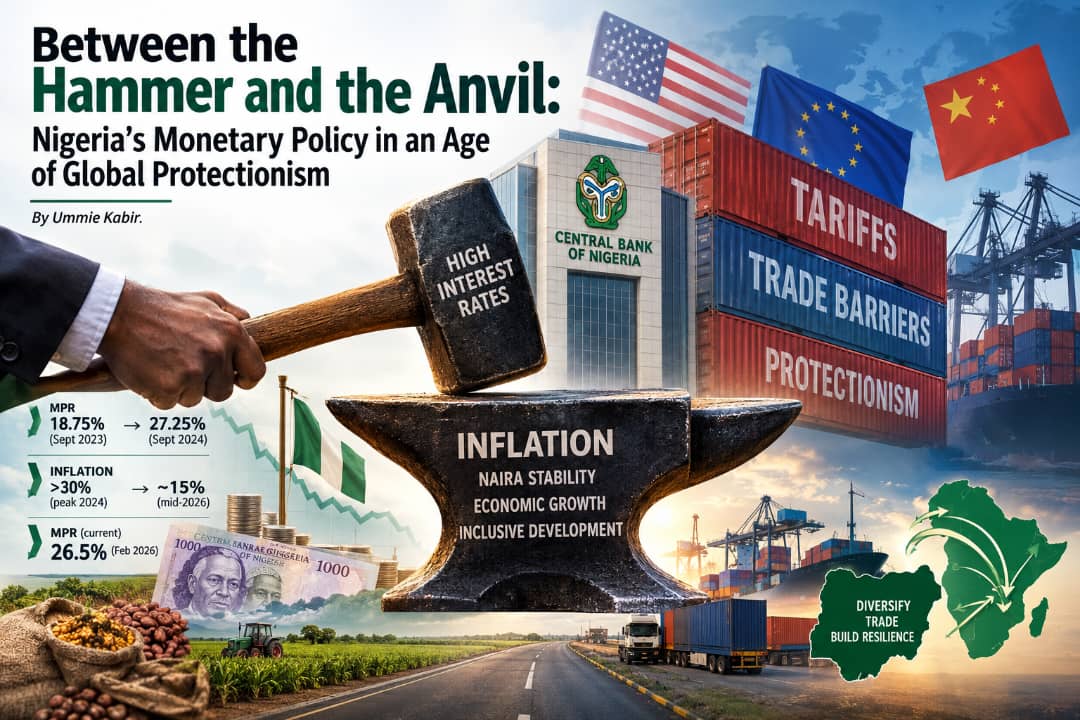
As inflation eases and the naira stabilises, structural weaknesses and rising trade barriers threaten to limit Nigeria’s economic recovery.
By Ummie Kabir
Nigeria’s monetary policy has delivered a measure of relief, but the gains may prove difficult to sustain unless the government addresses the structural weaknesses driving inflation and the growing barriers to global trade.
For nearly three years, the Central Bank of Nigeria (CBN) pursued one of the most aggressive monetary tightening campaigns in the country’s economic history. When Governor Olayemi Cardoso assumed office in September 2023, the benchmark Monetary Policy Rate (MPR) stood at 18.75 percent. By September 2024, successive rate hikes had pushed it to 27.25 percent, a level unseen in a generation.
The logic was straightforward. Inflation, which had climbed above 30 percent, was eroding household incomes and savings, weakening the naira’s purchasing power and threatening what remained of economic stability. Something had to be done, and the CBN chose to tighten.
That squeeze appears to have worked to a considerable extent. Headline inflation decelerated for roughly a year and a half, reaching around 15 percent by the middle of 2026, according to the National Bureau of Statistics.
The Monetary Policy Committee has since eased slightly, cutting the MPR by 50 basis points in February 2026 to 26.5 percent, where it has been retained through subsequent meetings as policymakers adopt what Cardoso has repeatedly described as a cautious stance.
The naira, once in freefall, has also shown surprising resilience through much of 2026, aided by improved liquidity in the foreign exchange market and rising external reserves, even as the US dollar strengthened globally.
But beneath these encouraging headline numbers lies a harder question: Can monetary policy, however well executed, solve Nigeria’s deepest economic problems?
And can it do so at a moment when the architecture of global trade—the openness that emerging economies like Nigeria have relied on to grow—is being steadily dismantled by some of the world’s most powerful economies?
Indicator| Movement
MPR| 18.75% → 27.25% → 26.5%
Inflation| Above 30% → Around 15%
Main challenge| Structural inflation
External risk| Rising protectionism
Proposed response| Diversification and regional trade
The limits of the interest-rate cure
Orthodox monetary policy assumes a fairly conventional transmission mechanism: raise interest rates, cool demand and tame inflation.
In Nigeria, however, that mechanism is distorted. A considerable proportion of inflation is not demand-driven but cost-push and structural, rooted in foreign exchange inadequacy, poor infrastructure, insecurity in farming communities and overreliance on imports, including refined petroleum products.
Bad roads add costs at every stage between farm and market. Higher interest rates do little to repair them or restore security to food-producing communities. They do even less to unclog the ports of Lagos or reduce the landing cost of imported diesel and other essential goods.
The CBN itself has acknowledged this tension. Cardoso has repeatedly cautioned that disinflation, though real, remains fragile, pointing to a surge of more than 200 percent in refined petroleum import licences as a fresh source of dollar demand and price pressure.
It is a reminder that Nigeria still imports much of the fuel that powers its own oil-producing economy—a peculiarity that has bedevilled policymakers for decades.
Meanwhile, the naira’s stability remains heavily dependent on volatile variables such as oil earnings, diaspora remittances and portfolio inflows, all of which can reverse when global risk appetite shifts.
“An economy cannot interest-rate its way to inclusive growth when its core problems are structural.”
A less forgiving global economy
If Nigeria’s domestic economic architecture presents one set of constraints, the international environment presents another—and it is becoming steadily less forgiving.
The past two years have seen a resurgence of economic nationalism among economies that once championed open trade. The United States, citing forced-labour concerns under Section 301 of its Trade Act, imposed tariffs of between 10 and 12.5 percent on imports from more than 80 countries in 2026, including Nigeria, following the earlier judicial invalidation of blanket reciprocal tariffs introduced under the Trump administration.
The European Union has tightened its carbon-border and standards regimes. China continues to protect strategic industries. Even multilateral institutions such as the World Trade Organisation, World Customs Organisation and United Nations Conference on Trade and Development have struggled to restrain the trend.
This is the paradox confronting developing economies. They are urged to liberalise, attract investment and integrate into global value chains even as the advanced economies that designed those rules increasingly retreat behind tariff walls, subsidy regimes and “friend-shoring” arrangements that can quietly exclude countries like Nigeria.
It is protectionism practised by the powerful and preached against the poor.
The real danger for Nigeria
Nigerian trade economists have pointed out that the direct harm from the latest US tariffs is limited. America is only Nigeria’s fifth-largest export destination, accounting for roughly 5.6 percent of the approximately $15.3 billion in exports recorded in the first quarter of 2026, behind India, France, the Netherlands and Spain.
Oil, gas and fertiliser exports, which dominate Nigeria’s trade with the US, were exempted outright.
But the danger is not really the tariff rate itself. It is what the tariff signals: a structural shift towards protectionism that could make it harder for Nigeria’s non-oil exporters in agriculture, textiles and light manufacturing to enter lucrative Western markets precisely when the country needs to diversify away from oil more urgently than ever.
Monetary policy remains pivotal because price stability is a precondition, not an obstacle, to sustainable growth. The CBN is right to insist that Nigerians cannot save, invest or plan around a currency in freefall.
But monetary policy alone cannot carry the burden of a structurally distorted economy.
A fiscal-monetary handshake
The way forward is for fiscal and monetary policy to pull in the same direction.
Years of deficit financing through the CBN’s “ways and means” facility helped fuel the inflation the Bank is now fighting. Fiscal discipline- broadening the tax net rather than simply raising tax rates, cutting waste and channelling savings from subsidy removal into productive infrastructure – must complement rather than undercut monetary tightening.
Cardoso has repeatedly urged fiscal authorities to maintain discipline, particularly around election-related spending, because loose fiscal policy can erase the gains of tight monetary policy overnight.
Nigeria must also treat export diversification as a national emergency, not a talking point.
Overdependence on crude oil, which still supplies the bulk of foreign exchange earnings, leaves the naira vulnerable to oil-price swings the country cannot control. Investment in agro-processing, solid-minerals value addition, textiles, and the digital and creative economy must move from policy documents to financed reality.
These are sectors where Nigeria has genuine comparative advantage and a youthful labour force. They need targeted, time-bound credit lines and an enabling business environment to thrive.
Credit for production, not speculation
Financial inclusion and targeted, cheaper credit for productive sectors must also be carved out of the current tight-money regime.
Blanket high interest rates that treat a rice farmer in Kebbi the same as a speculative forex trader in Abuja are not fair. Development finance institutions, agricultural credit-guarantee schemes and single-digit funding windows for manufacturing and export-oriented SMEs can allow the CBN to fight inflation at the macro level while keeping the taps open where the economy most needs oxygen.
The African opportunity
Looking beyond Nigeria’s shores for regional integration offers the clearest hedge against Western protectionism.
With roughly 1.3 billion consumers, the African Continental Free Trade Area (AfCFTA) is the market Nigeria is best placed to dominate—if it invests in the roads, power, ports and customs efficiency needed to move goods across the continent cheaply.
Growing intra-African trade would reduce Nigeria’s exposure to tariff shocks from Washington or Brussels far more effectively than diplomatic protest ever could.
The task ahead
Nigeria’s disinflation story is real and worth acknowledging. A rate of around 15 percent, compared with the inflation peak of 2024, is no small achievement.
But an economy cannot interest-rate its way to inclusive growth when its core problems are structural: import dependence, weak infrastructure, insecurity and an overconcentration in oil.
Nor can it diversify its way out of oil dependence into a global trading system that is growing more closed by the year unless it builds resilience closer to home through regional trade, domestic productivity and a fiscal-monetary handshake that has, for too long, pulled in opposite directions.
The choice before Nigeria is not between monetary orthodoxy and structural reform. It is whether the country can pursue both at the same time.
The task ahead is to do so deliberately and simultaneously, before the next external shock arrives.





Comment here