


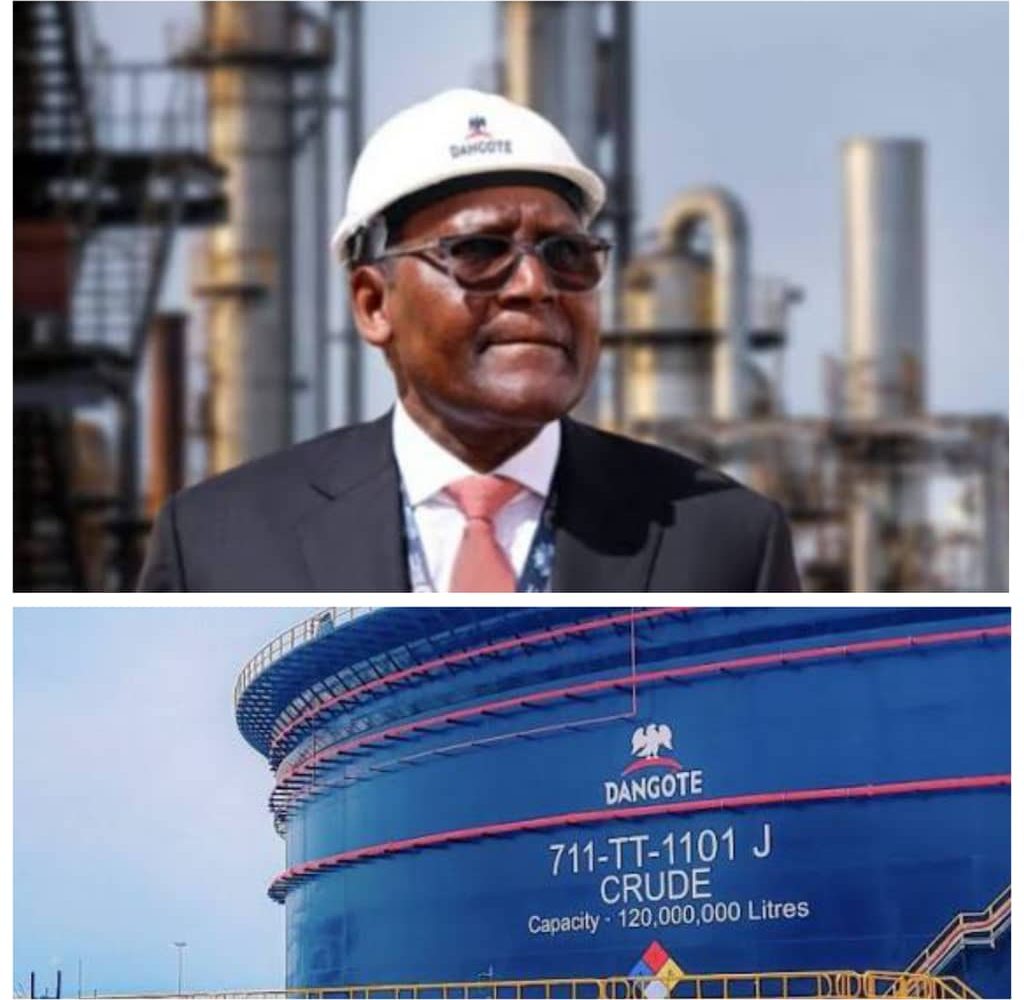
Dangote Petroleum Refinery & Petrochemicals is fundamentally transforming Nigeria’s downstream oil sector by significantly reducing the country’s reliance on imported refined petroleum products and strengthening foreign exchange earnings, according to the Economist Intelligence Unit (EIU).
In its latest assessment of Nigeria’s fuel market and regulatory environment, the EIU said the operational ramp-up of the 650,000 barrels-per-day refinery has reshaped a sector previously characterised by heavy dependence on imported fuel despite Nigeria being Africa’s largest crude oil producer.
The report stated that the refinery supplied nearly 80 per cent of Nigeria’s domestic petrol demand in April and has produced sufficient volumes to meet local consumption needs as it approaches full operational capacity.
Describing Nigeria’s downstream petroleum sector before the refinery as “long dysfunctional,” the EIU noted that the country had relied almost entirely on costly fuel imports while producing nearly 1.5 million barrels of crude oil daily.
According to the report, the emergence of the refinery has improved domestic fuel availability, reduced import dependence, and strengthened Nigeria’s balance of payments position through lower import demand and increasing exports of refined petroleum products.
“The gradual ramp up of the 650,000 barrel/day Dangote refinery since May 2023 has transformed Nigeria’s long dysfunctional downstream sector,” the report stated.
“The country’s main refineries, all state-owned, had been inoperative for years and Nigeria was almost entirely reliant on costly imported fuel.”
The EIU, the research and analysis division of The Economist Group, added that the refinery’s attainment of full operational capacity and planned future expansion would further support Nigeria’s economic growth and foreign exchange earnings in the coming years.
It projected that increased exports from the refinery, alongside plans to double production capacity before the end of the decade, would boost Nigeria’s real Gross Domestic Product (GDP) growth and forex inflows from 2026 onward.
Industry analysts said the refinery is positioning Nigeria as a major refining and export hub in Africa, potentially reshaping regional energy trade flows and reducing the continent’s dependence on imported fuel.
The EIU also noted that the refinery’s growth has coincided with major reforms in Nigeria’s downstream petroleum sector, including the removal of fuel subsidies and the introduction of market-driven pricing mechanisms.
However, the report observed that the shift from a state-dominated import structure to large-scale domestic refining has generated resistance from interests linked to the old import regime.
The latest controversy followed the decision by the Nigerian Midstream and Downstream Petroleum Regulatory Authority to relax restrictions on petrol imports despite the refinery’s increasing production capacity.
Dangote Industries Limited subsequently initiated legal action, arguing that continued import approvals undermine investments in local refining and contradict the objectives of the Petroleum Industry Act aimed at promoting domestic refining capacity.
Analysts further noted that the availability of large-scale domestic refining capacity has improved Nigeria’s energy security while reducing exposure to external supply shocks and foreign exchange volatility.
The Centre for the Promotion of Private Enterprise also warned against unrestrained fuel importation, saying such a policy could weaken Nigeria’s industrialisation drive and discourage investment in domestic refining.
Chief Executive Officer of the CPPE, Muda Yusuf, said continued dependence on imported fuel had historically exerted pressure on foreign reserves, contributed to exchange rate instability, and created fiscal leakages.
The refinery’s impact is also being reflected in Nigeria’s broader economic indicators. Earlier this month, S&P Global Ratings cited increased domestic refining capacity and rising hydrocarbon exports among the major factors supporting Nigeria’s sovereign credit rating upgrade, the country’s first in 14 years.
Beyond Nigeria, analysts said the refinery is increasingly being viewed as a strategic industrial asset for Africa, where many countries remain heavily dependent on imported refined petroleum products despite growing demand for transportation, manufacturing, and power generation.





Comment here