


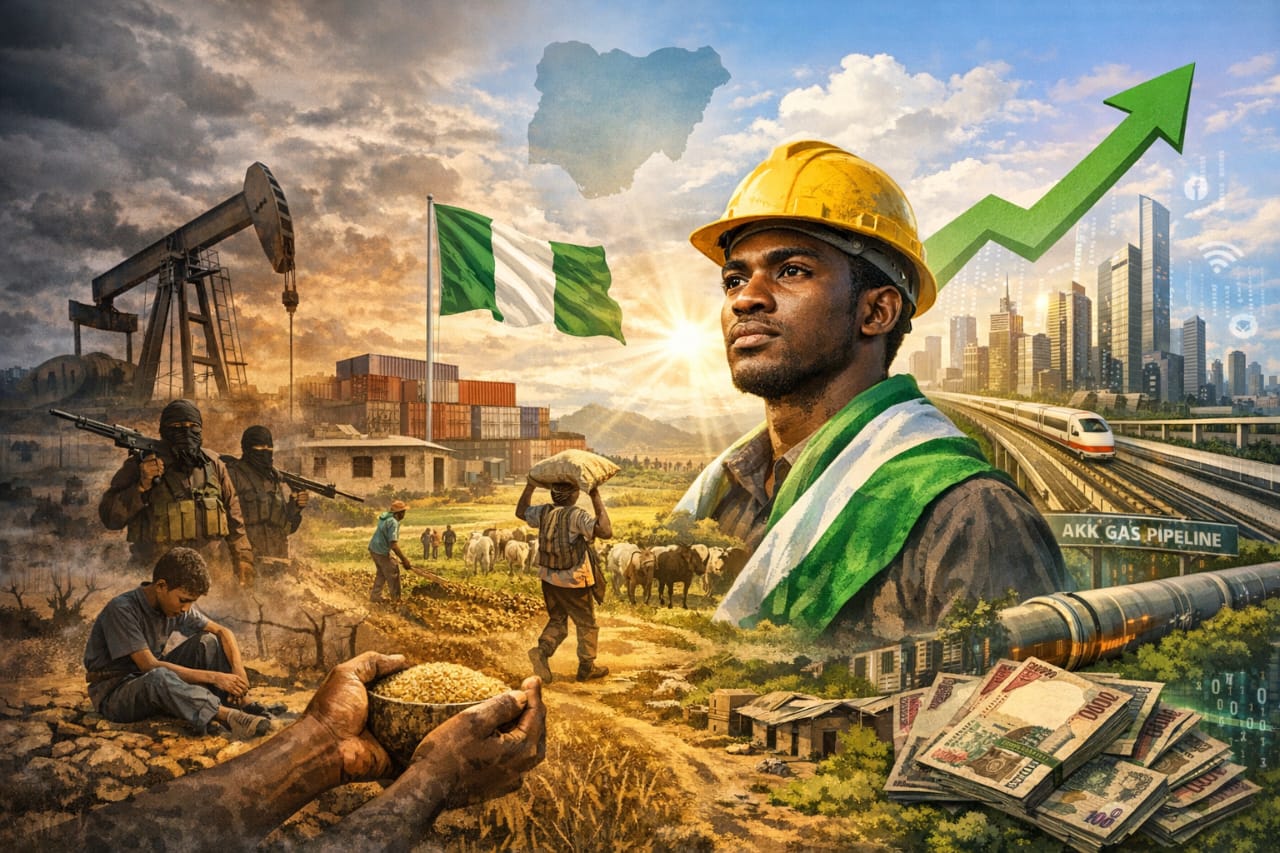
A country is classified as developed when it can provide a high quality of life for its citizens, regardless of social status. Unfortunately, for over six decades, Nigeria has continued to grapple with the challenges of development, despite its vast human and natural resources.
Development, as critical and desirable as it is, does not come as a free gift – it is the product of deliberate planning, consistent execution, and effective resource utilization.
Nigeria presents a paradox. Despite abundant resources, the country has struggled to harness them effectively to achieve sustainable development. More than six decades after independence, it continues to face widespread symptoms of underdevelopment.
A Worsening Development Profile
The situation is increasingly worrisome, as key socioeconomic indicators continue to decline. Social indicators – such as poverty rates, nutrition, life expectancy, maternal and child welfare, and access to quality education – paint a troubling picture.
Nigeria’s underdevelopment is marked by:
Endemic corruption and weak accountability in public office, Mismanagement of resources, High poverty, Inequality levels and Rising unemployment, especially among youth.
The economy remains largely monocultural, heavily dependent on oil exports as its primary revenue source. This overdependence exposes the country to global economic shocks. Meanwhile, the manufacturing sector remains weak due to significant infrastructure deficits, and inflation continues to persist at high levels.
The country also struggles with a low Human Development Index (HDI), driven by: A dysfunctional education system plagued by labour disputes, Inadequate healthcare services, Low literacy rates and Untapped Potential and Brain Drain.
Nigeria’s vast human and natural resources remain underutilized. Skilled professionals are often unmotivated, leading to a persistent “brain drain,” while natural resources are either neglected or exploited in an uncoordinated manner for the benefit of a few.
Low technical expertise, poor manpower deployment, and inadequate reward systems have worsened the situation, turning the country into a dumping ground for imported human capital under the guise of expatriate quotas.
Insecurity and Agricultural Decline
One of the most pressing challenges is insecurity, manifesting in insurgency, banditry, kidnapping, and violent agitations. These issues severely hinder development, particularly in rural areas.
Agriculture, once a backbone of the economy, has been significantly affected. Despite vast arable land and favorable climate conditions, Nigeria struggles to feed its population.
Challenges such as: Low mechanization, Policy inconsistency and Persistent insecurity have made the country a net food importer.
Farmers abandon fields due to fear of attacks, while herders face violent clashes over grazing routes. Entire communities have been displaced, leading to declining agricultural productivity.
Poverty, Population Growth, and Urban Pressure
Nigeria faces low per capita income, ranking around 146th out of 191 countries. According to a 2025 World Bank report, about 61% of Nigerians, approximately 139 million people, live below the poverty line, a sharp increase from 40% in 2019.
With a rapidly growing population estimated between 237.5 million and 242.6 million in 2026, Nigeria is: the most populous country in Africa, the sixth most populous globally. Despite a youthful population (median age of 18.1 years), low skill levels limit productivity and economic growth, trapping many in subsistence living.
Enduring Structural Challenges
Nigeria remains vulnerable to external shocks, including global crises such as tensions in the Middle East. Analysts consistently point to deeply rooted structural issues behind the country’s underdevelopment, including: Weak institutions, Corruption, Poor infrastructure and Failure to diversify the economy.
These challenges have led to unemployment, poverty, and continued emigration of skilled workers.
Development Efforts and Policy Frameworks
Nigeria has never lacked development strategies. From the 1946–1956 Colonial Plan to post-independence National Development Plans (1962–1985), rolling plans (1990–2007), and recent frameworks, the country has consistently outlined ambitious goals.
Key Recent Initiatives Include:
National Development Plan (2021–2025): Targets 21 million jobs and lifting 35 million people out of poverty
Economic Recovery and Growth Plan (2017–2020)
Nigeria Agenda 2050: Focuses on long-term economic transformation. The 10-year Industrial Policy Roadmap (2025–2035) aims to transition Nigeria into a $1 trillion economy by 2035 through value addition and industrialization.
Emerging Development Priorities
Nigeria’s development strategy is increasingly focused on: Energy, Security, Regional connectivity and Digital economy expansion.
Major infrastructure projects include: Lagos-Calabar Coastal Highway (700km) and Ajaokuta-Kaduna-Kano (AKK) Gas Pipeline. Digital initiatives like Project BRIDGE aim to transform Nigeria into a digital-first economy.
The Way Forward
Nigeria’s development should not be seen as a threat to global partners but as an opportunity for shared prosperity. A stable and industrialized Nigeria would strengthen regional supply chains, enhance security, and expand markets across Africa.
Addressing underdevelopment requires a multi-pronged approach: Diversifying the economy away from oil, Strengthening industrialization, Revitalizing agriculture and Tackling insecurity.
The role of the Central Bank of Nigeria (CBN) is critical, not only in monetary policy but also in development financing. Collaboration between government institutions is essential to redirect the economy toward sustainable growth.
Infrastructure and Power as Catalysts
Massive investment in infrastructure, particularly power and transportation, is non-negotiable. Reliable electricity remains fundamental to economic development, and resolving the country’s persistent power challenges is urgent.
Security and Governance
The Nigerian Constitution emphasizes that “the security and welfare of the people shall be the primary purpose of government.” This principle must be fully realized through decisive actions to combat insecurity, especially in key agricultural regions.
Fighting Corruption
Curbing corruption is essential for unlocking Nigeria’s potential. It undermines economic progress, distorts resource allocation, and erodes public trust. Strong institutions and accountability mechanisms must be prioritized.
Conclusion
Nigeria does not need to reinvent the wheel. By diversifying its economy, closing its estimated $100 billion infrastructure gap, investing in human capital, and embracing technology, the country can chart a sustainable path to prosperity.
The task ahead requires urgency, commitment, and a clear vision. Nigeria must act decisively, not just for its own future, but for the stability and growth of the entire African continent.





Comment here