


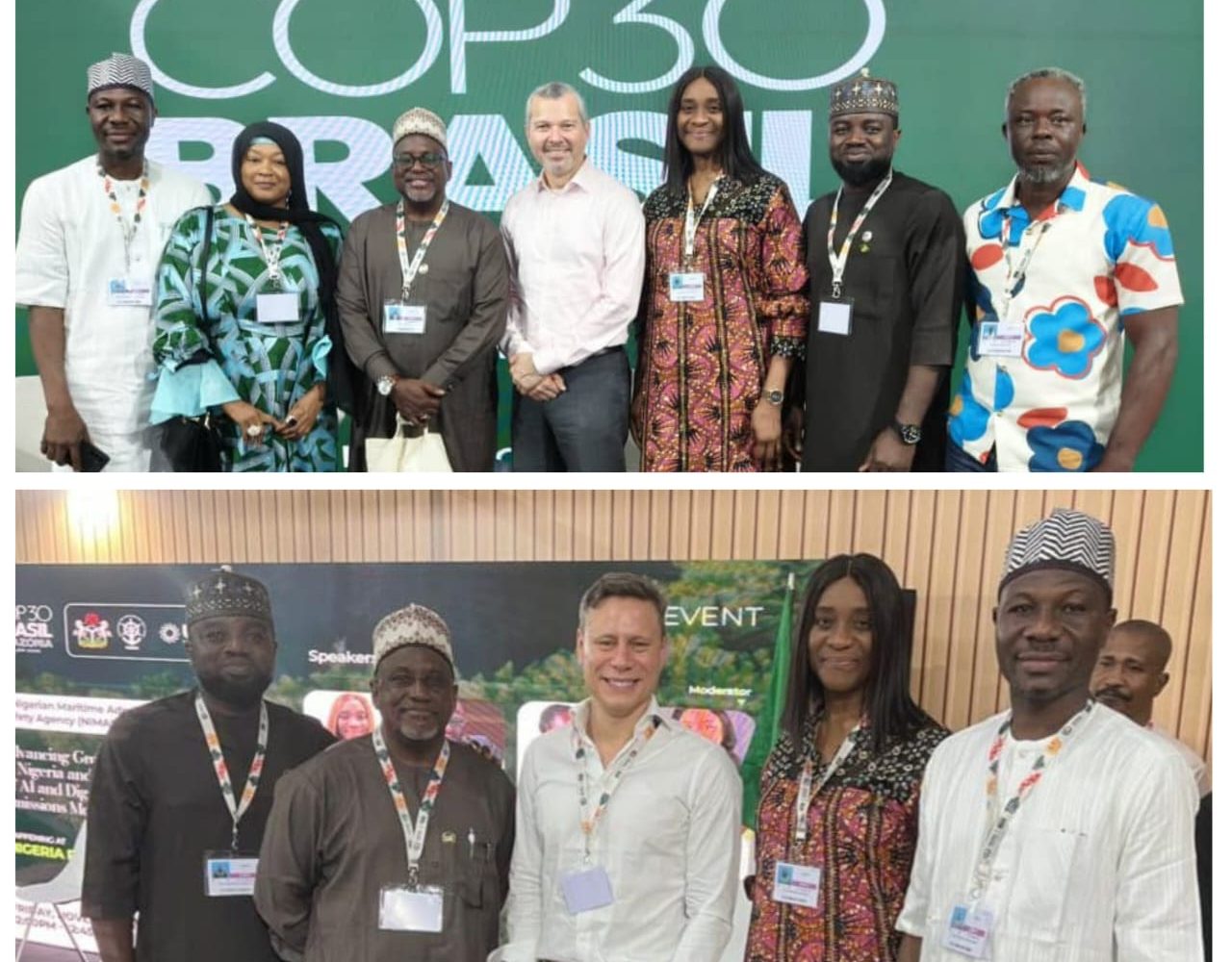
The Nigerian Maritime Administration and Safety Agency (NIMASA) has made a significant breakthrough in African maritime decarbonisation by unveiling a pioneering Public Private Partnership (PPP) model at the 2025 UN Framework Convention on Climate Change (UNFCCC COP 30) in Balem, Brazil.
The agency showcased the Nigerian Maritime Continuous Emissions Monitoring System, developed in collaboration with researchers from University College London (UCL).
NIMASA’s Director of Marine Environment Management Department, Dr. Oma Ofodile, represented the agency’s Director General, Dr. Dayo Mobereola, and highlighted the agency’s consistent efforts towards energy transition in the maritime industry.
She emphasised NIMASA’s commitment to advancing the International Maritime Organisation (IMO) energy transition strategies through digital innovation.
The event featured expert speakers from IMO, UCL, and maritime administrations from Ghana, Kenya, and Tanzania.
The representative of the IMO Secretary General, Roel Hoeders, commended NIMASA for organising a novel session to deepen discussion on shipping energy transition challenges in Africa.
A key expectation for UNFCCC COP 30 is to reach an agreement on indicators for measuring progress towards the Global Goal on Adaptation (GGA) established in the Paris Agreement.
This would culminate a process to narrow down a set of 100 indicators matching the 11 targets of the 2023 GGA Framework.






Comment here