


By Barnabas Esiet.
Nigeria’s maritime sector may be approaching a turning point as the Federal Government steps up efforts to reform port regulation, modernise infrastructure and improve access to financing for indigenous shipowners.
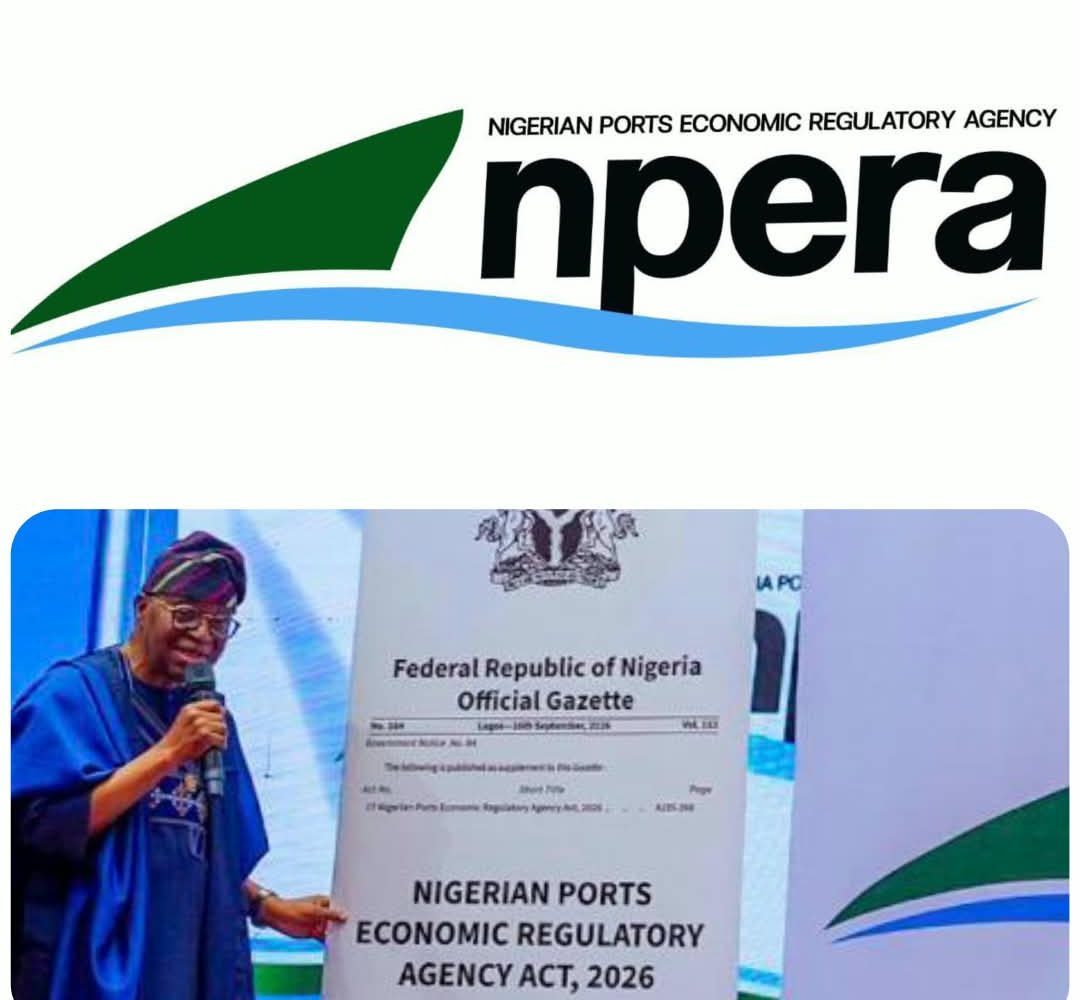
At the centre of the renewed push is the unveiling of the gazetted Nigeria Ports Economic Regulatory Agency (NPERA) Act, 2026, by the Minister of Marine and Blue Economy, Dr Adegboyega Oyetola, alongside a fresh commitment to accelerate the disbursement of the long-awaited Cabotage Vessel Financing Fund (CVFF).
Oyetola announced the initiatives at the Third Quarter 2026 Citizens’ and Stakeholders’ Engagement of the Federal Ministry of Marine and Blue Economy in Lagos, where he outlined the government’s plans to make Nigeria more competitive as a maritime and logistics hub.
The NPERA Act, which received President Bola Ahmed Tinubu’s assent in June 2026, establishes a statutory framework for port economic regulation after years of efforts to institutionalise the function.
The new agency is expected to regulate port charges and tariffs, promote competition, enforce service standards and protect port users from unfair practices.
For an industry where the cost and efficiency of port operations directly affect trade, the effectiveness of the new regulator could prove crucial to attracting investment and improving Nigeria’s business environment.
Oyetola has directed the constitution of a ministerial committee to oversee the transition of the Nigerian Shippers’ Council, which has served as interim port economic regulator since 2014, into NPERA.
He stressed that the agency must operate independently and impartially to inspire confidence among investors and industry operators.
But regulation is only one part of the challenge. Access to financing remains critical to building a stronger Nigerian shipping fleet.
Reaffirming the government’s commitment to indigenous shipowners, Oyetola disclosed that he had directed the Nigerian Maritime Administration and Safety Agency (NIMASA) to work with approved Primary Lending Institutions to accelerate the processing and disbursement of the CVFF to qualified applicants.
The fund is expected to help eligible Nigerian operators acquire vessels, expand their businesses and compete more effectively in domestic shipping.
Its successful deployment could also stimulate investment in shipbuilding, marine engineering, vessel maintenance and maritime logistics.
For indigenous operators, however, the key test will be translating the government’s renewed assurances into accessible financing and tangible business opportunities.
The government is also pursuing a wider infrastructure programme covering the modernisation of Apapa, Tin Can Island, Onne, Rivers, Delta and Calabar ports.
It has equally approved the development of the proposed Ibom, Bakassi, Agge, Gateway, Ondo and Bonny Deep Seaports to expand capacity and strengthen Nigeria’s regional logistics ambitions.
Oyetola said the modernisation programme would ensure that ports across the country benefit from infrastructure development, rather than concentrating investment in Lagos.
Security remains another pillar of the government’s strategy. The minister cited Nigeria’s record of zero piracy incidents in its territorial waters through the Deep Blue Project and the lifting of the United States Coast Guard’s 12-year Condition of Entry on vessels arriving from Nigeria in August 2026.
He also highlighted Nigeria’s international maritime partnerships, including engagements with Denmark, India, Norway and the United Kingdom.
At the event, Denmark’s Ambassador to Nigeria, Jens Ole Bach Hansen, delivered a presentation on his country’s experience in building a sustainable blue economy, focusing on strategic partnerships, investment and technology transfer.
Ultimately, the success of the government’s maritime agenda will depend on implementation: whether NPERA delivers credible regulation, port upgrades improve efficiency, and the CVFF reaches qualified Nigerian shipowners.

For Nigeria, the opportunity goes beyond better ports. It is about building a maritime economy in which local operators can access capital, compete effectively and capture a greater share of the value generated by the country’s growing trade.





Comment here