


By Barnabas Esiet.
The Nigeria-China Trade and Investment Forum at the Nigerian Institute of International Affairs (NIIA), Lagos, has brought renewed attention to the opportunities and challenges surrounding Nigeria’s trade relationship with China.
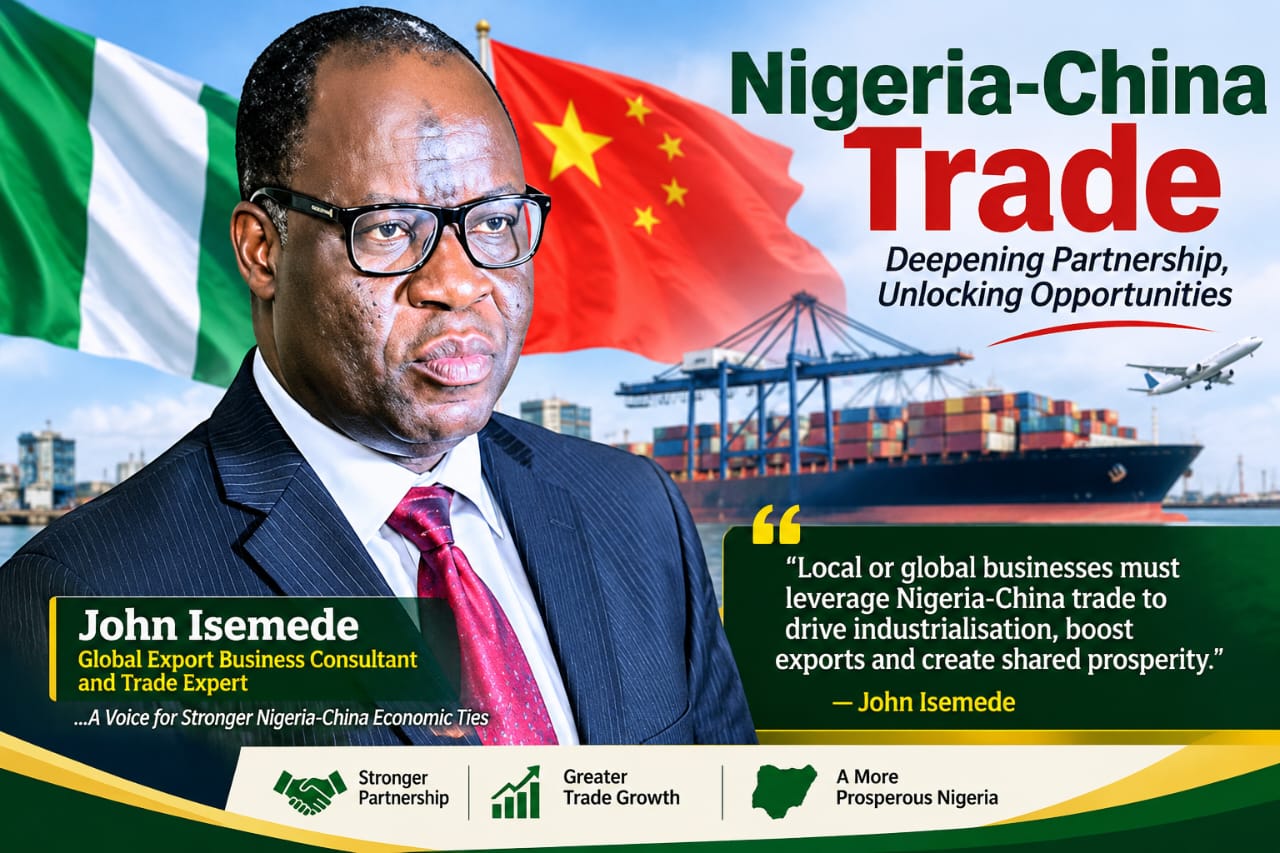
One of the notable contributions came from John Isemede, an international trade expert, former Director-General and Chief Executive Officer of the Nigerian Association of Chambers of Commerce, Industry, Mines and Agriculture (NACCIMA), and global export value-chain consultant.
Drawing on decades of experience in international trade and private-sector development, Isemede challenged Nigerian policymakers and business stakeholders to look beyond the attraction of zero import tariffs and address the fundamental issues affecting the country’s export competitiveness.
His central question was direct: What is zero tariff without non-tariff measures?
For Isemede, the proposed zero-tariff opportunity is welcome, but it must not become another international trade arrangement in which Nigeria celebrates market access without developing the capacity to take advantage of it.
Beyond the attraction of zero tariff
According to the trade expert, eliminating import duties on Nigerian products entering China is only one part of a much bigger international trade relationship.
He argued that Nigerian businesses must also be equipped to satisfy China’s technical and regulatory requirements.
These include product quality, packaging, technology, accreditation, certification, traceability and proper export documentation.
Without these supporting structures, Nigerian agricultural and manufactured products could still experience rejection in the Chinese market despite enjoying preferential tariff treatment.
Isemede maintained that Nigeria must understand the difference between being offered access to a foreign market and having the capacity to compete successfully in that market.
He called for stronger technical cooperation between Nigeria and China, particularly in developing production systems, quality infrastructure and export value chains.
Nigeria and China must benefit equally
Another major issue raised by Isemede was the principle of reciprocity.
He questioned the idea of discussing opportunities for Nigeria without equally considering the opportunities available to China.
According to him, international business relationships should not operate on a master-servant basis.
He recalled a similar engagement in December 2013, when he was Director-General of NACCIMA and Nigeria’s current Minister of Foreign Affairs was serving as ambassador to Spain.
At that engagement, he said he made it clear that Nigeria was not seeking to beg or flatter its trading partner but to establish a relationship based on mutual engagement.
He believes the same principle should guide Nigeria’s relationship with China.
He also commended the Chinese Consul-General for engaging the Nigerian Institute of International Affairs, describing the move as a positive first step towards understanding Nigeria’s foreign policy, economic diplomacy and trade environment.
However, he recommended that the next step should be engagement with NACCIMA and other organised private-sector institutions.
His argument is that business organisations must have a meaningful role in discussions that directly affect Nigerian businesses.
Lessons from previous trade agreements
Isemede warned that Nigeria must learn from previous international trade arrangements.
He referred to the African, Caribbean and Pacific relationship with the European Union, the African Growth and Opportunity Act (AGOA), the D-8 arrangement and the trade relationship with the United Kingdom following Brexit.
His concern was that signing international agreements does not automatically translate into industrial development, increased exports or employment opportunities.
He argued that Nigeria must examine what it has achieved from previous agreements before embracing another arrangement without adequate preparation.
He further stressed that international trade agreements should be supported by clear implementation plans, domestic policies and institutions capable of monitoring their outcomes.
The manufacturing and export infrastructure challenge
The former NACCIMA chief executive also drew attention to the gap between Nigeria’s manufacturing capacity and that of China.
He observed that China’s manufacturing sector contributes a substantially larger share of its national economy than Nigeria’s manufacturing sector.
He attributed Nigeria’s weak manufacturing performance partly to inadequate infrastructure, insufficient incentives, expensive financing and limited export support services.
According to him, Nigerian manufacturers need access to affordable finance, reliable electricity, modern production technology and efficient logistics.
He also highlighted the importance of pre-shipment and post-shipment inspection services, international certification and shipping infrastructure.
Without these facilities, he warned, Nigerian businesses would continue struggling to compete with countries that have invested heavily in their industrial and export systems.
The currency question and financing Nigerian businesses
Isemede also raised concerns about currency arrangements between Nigeria and China.
Reflecting on the naira-yuan currency-swap discussions, he questioned how Nigerian businesses could effectively participate in international trade when the domestic currency was experiencing considerable depreciation.
He also expressed concern about the high cost of borrowing and its impact on local manufacturers.
He argued that Nigeria should examine the financing support available to businesses in countries such as China and develop comparable mechanisms to strengthen domestic production.
His position was that the risks associated with exchange-rate movements and financing arrangements must be properly assessed before Nigeria commits itself to international trade agreements.
Nigeria must build the quality infrastructure
One of the strongest points in Isemede’s presentation was his emphasis on non-tariff barriers.
He explained that international markets operate with technical requirements that go beyond import duties.
A Nigerian exporter may be allowed to send agricultural produce to China at zero per cent duty, but the product must still satisfy the relevant standards.
This requires proper packaging, quality assurance, certification, accreditation and traceability.
He called for stronger cooperation with technical organisations and educational institutions to improve Nigeria’s quality infrastructure.
He also suggested that China could support Nigerian universities and other institutions through technical training, language development and skills acquisition.
For him, trade cooperation should involve transferring knowledge and developing the human capacity needed to compete internationally.
Nigeria’s opportunity is bigger than Nigeria
Isemede also argued that Nigeria’s trade opportunities should be considered within the wider African market.
As a major economy in West Africa and an important member of ECOWAS and the African Continental Free Trade Area, Nigeria has the potential to serve as a gateway for trade across the continent.
He maintained that a successful Nigeria–China trade relationship could benefit businesses beyond Nigeria if the appropriate regional structures were established.
He therefore encouraged stakeholders to develop export systems that connect Nigerian farmers, processors, manufacturers, packaging companies, freight forwarders and logistics operators.
He also raised concerns about Nigeria’s limited participation in international shipping and logistics, arguing that the country must rebuild its capacity in these areas.
Twenty-one reasons Nigeria must take export development seriously
In explaining the opportunities available through international trade, Isemede outlined several benefits of export development.
These include access to new markets, increased profitability, employment generation, improved capacity utilisation, foreign-exchange earnings, technology transfer, product diversification, international recognition and business expansion.
He also highlighted the importance of market segmentation, seasonal opportunities, risk management and specialisation.
According to him, Nigerian businesses must identify products that have strong demand abroad, even where those products may not have sufficient domestic markets.
He cited agricultural commodities such as yam and cassava as examples of products that could offer Nigeria opportunities in international markets.
His argument was that Nigeria must stop looking only at what it imports and begin identifying what it can produce, process and export competitively.
A call for preparation, not celebration
Concluding his presentation, Isemede welcomed China’s willingness to explore preferential trade opportunities with Nigeria.
However, he insisted that the country must not mistake an attractive tariff arrangement for a complete trade development strategy.
He called on the Federal Government, organised private-sector institutions, manufacturers, exporters and other stakeholders to work together in building the infrastructure required to make the arrangement successful.
He emphasised that the proposed agreement must comply with Nigeria’s constitutional and legislative requirements and that the private sector must not be excluded from important discussions.
His final message was a call for fairness, transparency and mutual benefit.
Nigeria, he argued, must be prepared to engage China, compete with China and build the domestic structures required to benefit from the relationship.
The central lesson from Isemede’s intervention is that zero tariff may open the door, but technology, quality, production capacity, financing and export infrastructure will determine whether Nigerian businesses can walk through it.
The Nigeria–China trade relationship, therefore, should not be measured only by the concessions offered but by the actual opportunities created for Nigerian producers, manufacturers, exporters and workers.




Comment here