


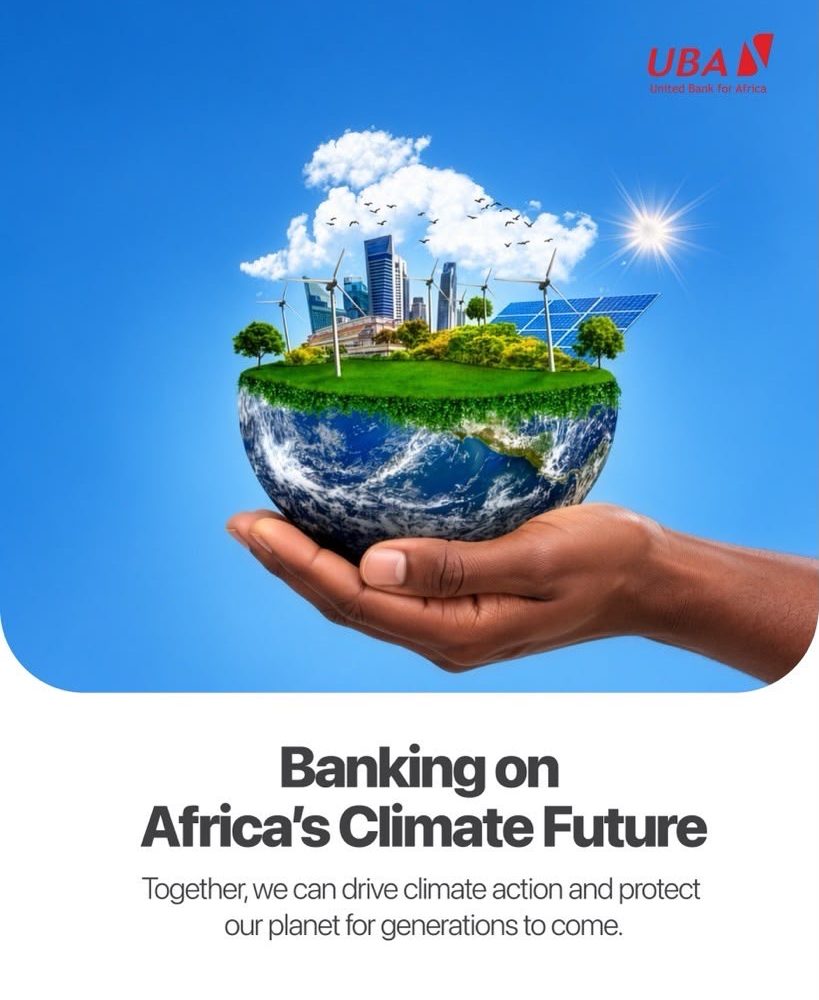
United Bank for Africa (UBA) Plc has launched a five-day Climate Action Week to promote environmental awareness, responsible waste management and sustainable financing across its African and international operations.
The campaign, themed “Banking on Africa’s Climate Future,” runs from October 26 to 30, 2026, and seeks to encourage employees, customers and other stakeholders to adopt environmentally responsible practices while highlighting the role of financial institutions in addressing climate change.
As part of the initiative, UBA has deployed waste segregation bins across its offices and introduced measures to reduce the use of single-use plastics at its head offices.
The bank will also use its media and digital platforms throughout the week to educate the public on climate change and its effects on food prices, energy consumption and urban flooding.
Other areas of focus include responsible plastic disposal, recycling and the financing of clean energy, sustainable agriculture and other environmentally friendly businesses.
UBA Group Managing Director and Chief Executive Officer, Oliver Alawuba, said climate change was increasingly affecting everyday life across Africa, making collective action necessary to protect communities and support economic development.
“Climate change is no longer a distant environmental concern; it is increasingly shaping everyday life across Africa. We see its effects in rising food costs, increased energy demand and flooding that disrupts homes, businesses and livelihoods,” Alawuba said.
He explained that the bank was encouraging employees, customers and other stakeholders to embrace sustainable habits in their workplaces, homes and communities.
According to him, the initiative reflects UBA’s commitment to translating sustainability principles into practical actions while encouraging stakeholders to contribute to a greener future.
As part of its community engagement programme, UBA employees will participate in a group-wide clean-up exercise on November 7 across major cities in its markets.
In Nigeria, the exercise will take place in Lagos, Kano and Port Harcourt, where staff volunteers are expected to contribute to cleaner and healthier communities.
The bank will also sponsor Climate Convergence Week in Lagos on October 30, participating in a speaking session and panel discussion on sustainable finance and climate resilience.
The engagement will provide an opportunity for UBA to showcase its Green Finance offering, highlight its sustainability initiatives and examine how financial institutions can support Africa’s transition to a more sustainable and climate-resilient economy.
Alawuba noted that climate-related risks were becoming increasingly important to business continuity, risk management and long-term economic growth.
He said climate change could affect operating costs, business performance and the sustainability of enterprises, making environmental considerations essential for businesses and the financial institutions that support them.
“Through UBA Green Finance, we seek to support eligible businesses investing in cleaner technologies and more sustainable operations,” he said.
He added that helping businesses access appropriate financing solutions would strengthen private-sector resilience and create opportunities for sustainable economic growth across Africa.
In another development, UBA is set to join the Sustainability Professionals Institute of Nigeria (SPIN) to strengthen its environmental, social and governance (ESG) capabilities.
The move is expected to deepen the bank’s sustainability expertise and support the professional development of employees working in sustainability-related fields.
The Climate Action Week forms part of UBA’s broader sustainability strategy, which integrates environmental responsibility into its Customer First philosophy through responsible business practices, employee engagement, community initiatives and green financing.
By combining public awareness campaigns with practical environmental activities and financing solutions, the bank aims to encourage sustainable practices while helping businesses and communities respond to the challenges and opportunities presented by climate change.
UBA operates in 20 African countries, as well as the United Kingdom, the United States, France and the United Arab Emirates. The financial institution has approximately 25,000 employees and serves more than 45 million customers globally, providing retail, commercial and institutional banking services.





Comment here